 from MANDATE: The International Magazine About Men.
December 1977, page 70.
For details, click the image; then click again to magnify.
For details, click the image; then click again to magnify.
Cream colored. Heh.

Ponders the myriad pathologies of pop culture.
Obsesses about actressing at the edges.
Loves grilled cheese.
ARCHIVE OF SUPPORTING ACTRESS SUNDAYS & THE SMACKDOWN
from MANDATE: The International Magazine About Men. The first time lil Lulu screened Heaven Can Wait, 'twas sometime in the very late 70s or very early 80s. 'Twas also a somewhat secret screening, a film somehow identified as off-limits, as too mature for lil Lulu, prolly by Bobby's mother. (Bobby was Lu's 5th grade best friend, a snarky kid who was such total boy that lil Lulu was shocked he wanted to be best friends. Bobby also was the baby of a family newly aswim in cash, which meant that Bobby had -- or had access to -- the best toys. Including a betamax machine.) Bobby and Lulu shared a love for all things television and for all forbidden things. So, when Bobby's mom forbade our watching Heaven Can Wait, 'twas merely a matter of time before we popped that videocassette in the machine for a sneak screening. 'Spose we expected some dirty sex comedy (somehow we knew 'twas a comedy) and, lo, were we disappointed. Not only was there no filth, but there was no funny. We just didn't get it. Though we did maintain high hopes, o'course, through the entire film that a certain actress would all of a sudden get all naked to satisfy our craving for illicit thrills, an actress with really big hair by the name of...
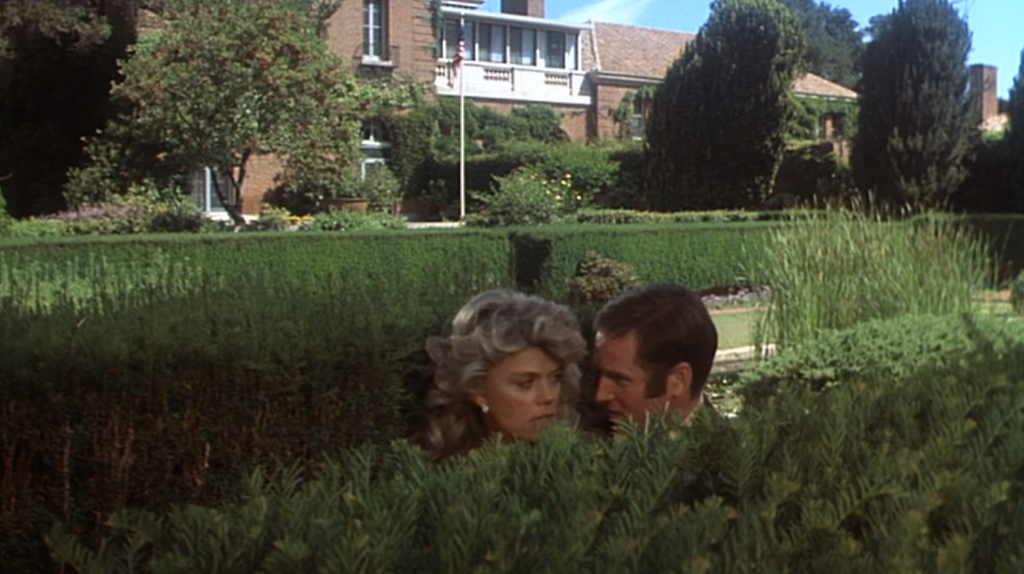 The character of Julia is a fleeting, glancing but somehow constant presence in the film. She's a foil really -- the shrewish wife designed to counterbalance the redeeming daughter/romantic heroine (played with elevating easy charm by Julie Christie).
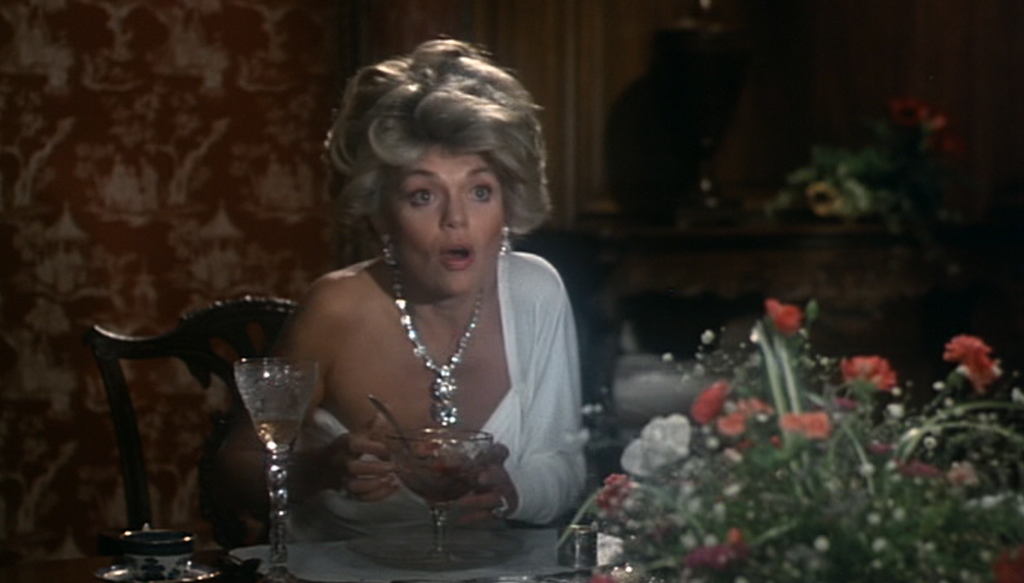 The role really requires Cannon only to make a vividly bad impression, that she be an immediately and legibly awful person. To that end, Cannon's performance draws upon her most substantial gifts as a performer: her distinctive looks, loud voice, zesty screen presence, and formidable hair.
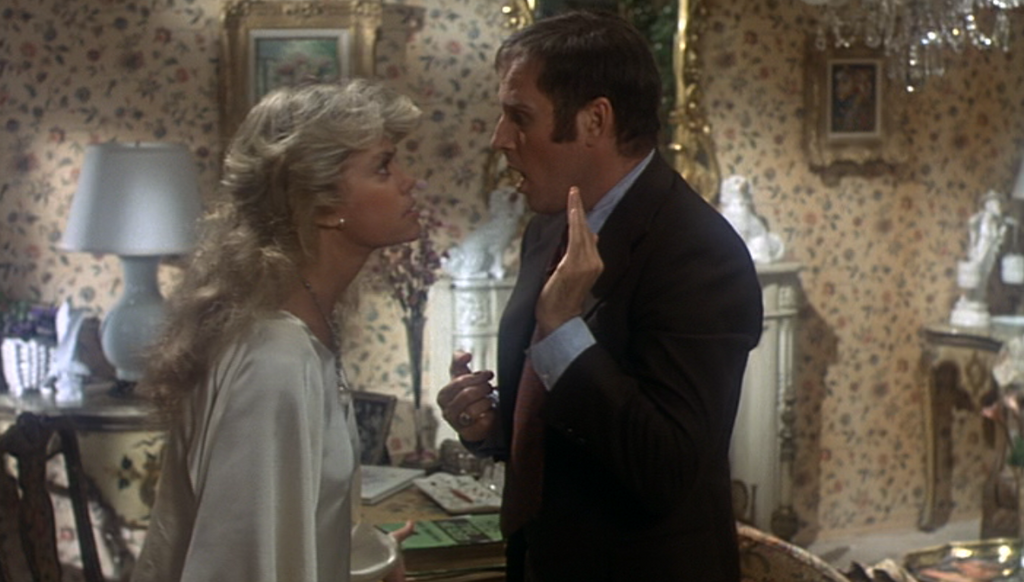 Unfortunately, though, the film pairs Cannon's Julia with Charles Grodin, an actor of strange intelligence, palpable sleaze and genius timing. The two could not be less suitably matched, and this mismatch neutralizes the particular gifts each brings to their respective roles. Cannon's charm wilts next to Grodin's mild ickiness. Grodin's deft delivery smacks flat against Cannon's chattering and braying. And the two make such a preadolescent show of sexual chemistry that the whole scenario begins to seem just implausible. (Truly. Grodin maintained a more believable erotic connection with Miss Piggy in The Great Muppet Caper...)
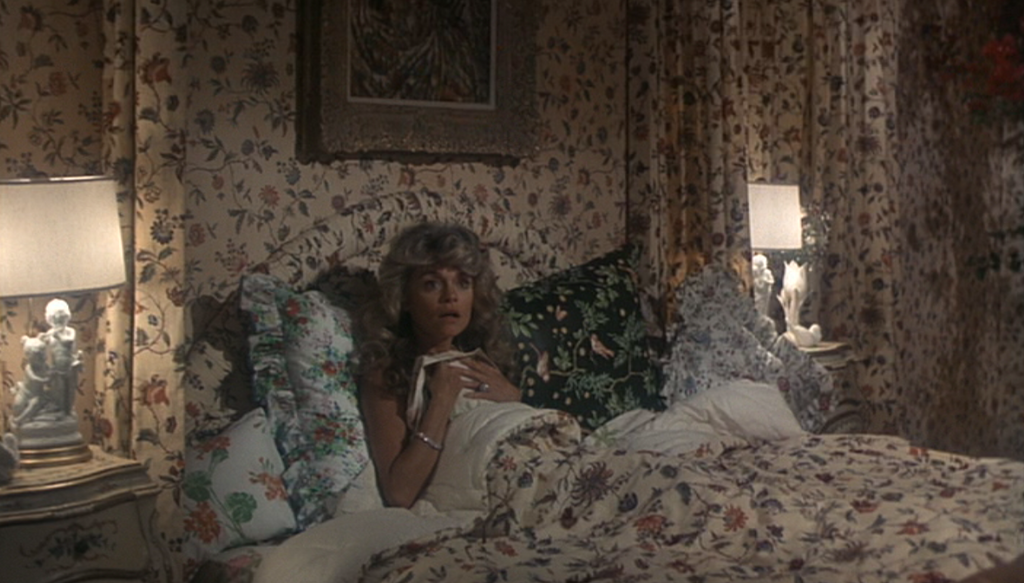 To be sure, Cannon's work -- so often framed in wide, elaborately designed set ups -- is sometimes dwarfed on the smaller screen. But even then, Cannon's Julia remains in the realm of the comic cardboard cutout... without the particular, idiosyncratic flourishes necessary to elevate the performance beyond stock comedy schtick.
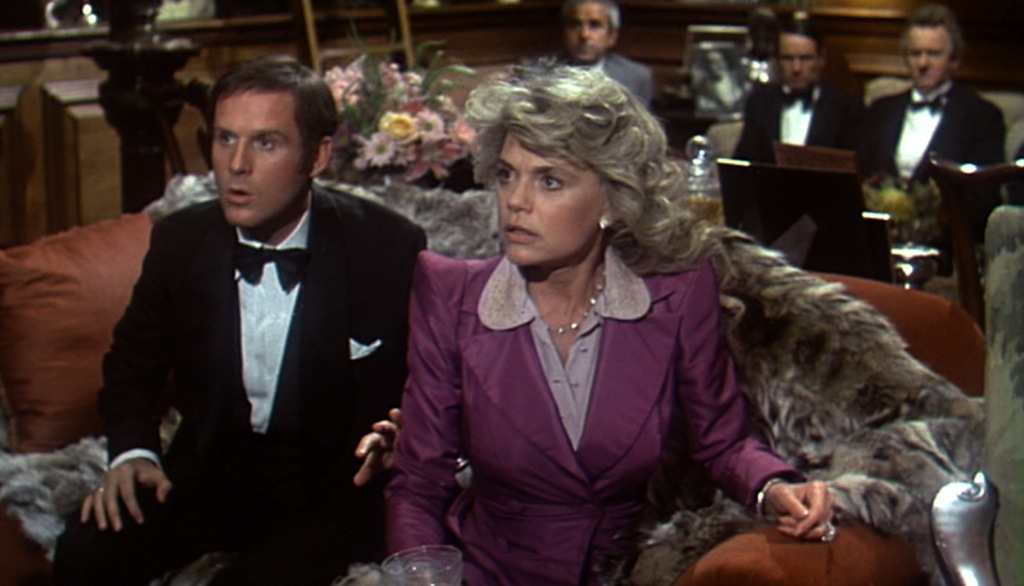 And, in the end, StinkyLulu's reaction to Dyan Cannon's performance is much the same as 'twas when Bobby and lil Lulu watched Heaven Can Wait back in the day: just don't get it. Kept waiting for Dyan Cannon to whip out some major actressexual charms, but -- in the end -- it seems that StinkyLulu just doesn't get the particular joke of this beloved film. Let alone the appeal of this acclaimed performance...
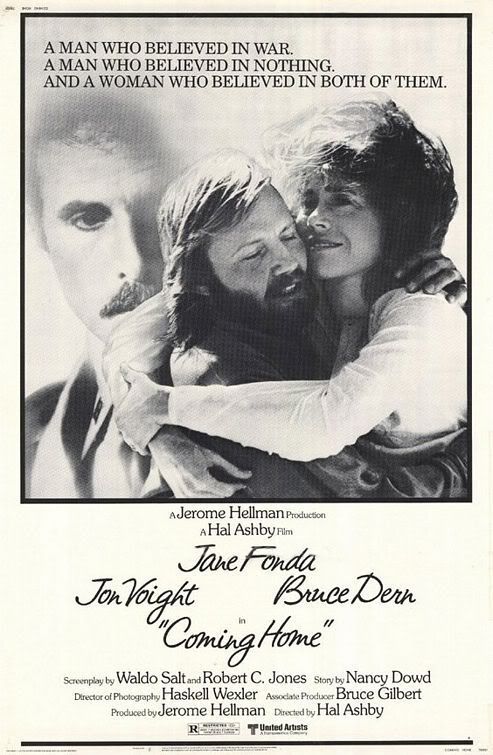
There's a heart-stopping line in Sarah Polley's recent feature, Away From Her, in which Julie Christie's character (a woman lapsing ever further into Alzheimer's-related dementia) has a chilling moment of lucidity. Placidly watching a news report about the wars in the Middle East, she turns to her husband and asks: "Don't they remember Vietnam?" The simple poignancy of this moment in Away From Her -- the loss of history as both a personal and national tragedy -- haunted StinkyLulu's screening of Hal Ashby's film about the home front during the Vietnam era, Coming Home, a film which -- nearly three decades after its release -- offers unexpected and timely chills. Hal Ashby's film depicts the experience of veterans, their families and their caregivers in 1968 (in the months immediately after the Tet Offensive, the cataclysmic battle that inspired both a retaliatory "surge" by the U.S. military and which, concomitantly, marked the greatest number of U.S. casualties in the history of the conflict). And while Coming Home's narrative structure is built mostly around the dramatic romance that emerges between Sally The Officer's Wife and Luke The Paralyzed Enlisted Man (Jane Fonda and Jon Voight, in trophy snagging performances), the film operates as an intimate chamber piece for four voices, incorporating the blistering nominated performance by Bruce Dern as Fonda's husband and, as a party girl caught up in the sweeping carnage of war...
And, in the end, StinkyLulu's reaction to Dyan Cannon's performance is much the same as 'twas when Bobby and lil Lulu watched Heaven Can Wait back in the day: just don't get it. Kept waiting for Dyan Cannon to whip out some major actressexual charms, but -- in the end -- it seems that StinkyLulu just doesn't get the particular joke of this beloved film. Let alone the appeal of this acclaimed performance...
There's a heart-stopping line in Sarah Polley's recent feature, Away From Her, in which Julie Christie's character (a woman lapsing ever further into Alzheimer's-related dementia) has a chilling moment of lucidity. Placidly watching a news report about the wars in the Middle East, she turns to her husband and asks: "Don't they remember Vietnam?" The simple poignancy of this moment in Away From Her -- the loss of history as both a personal and national tragedy -- haunted StinkyLulu's screening of Hal Ashby's film about the home front during the Vietnam era, Coming Home, a film which -- nearly three decades after its release -- offers unexpected and timely chills. Hal Ashby's film depicts the experience of veterans, their families and their caregivers in 1968 (in the months immediately after the Tet Offensive, the cataclysmic battle that inspired both a retaliatory "surge" by the U.S. military and which, concomitantly, marked the greatest number of U.S. casualties in the history of the conflict). And while Coming Home's narrative structure is built mostly around the dramatic romance that emerges between Sally The Officer's Wife and Luke The Paralyzed Enlisted Man (Jane Fonda and Jon Voight, in trophy snagging performances), the film operates as an intimate chamber piece for four voices, incorporating the blistering nominated performance by Bruce Dern as Fonda's husband and, as a party girl caught up in the sweeping carnage of war... While Sally volunteers as a kind of grown-up candystriper in the rehab ward of the veterans hospital, Milford's Vi is stuck toiling as a nutritionist in the hospital kitchen. And it quickly becomes clear that for all her drinking, toking and sleeping around, Vi's party girl habits are mostly her way of blowing off steam. The real reason Vi's sticking so close to the military hospital? So she can be close to her kid brother Bill (David Carradine, in an efficiently devastating performance), a veteran who returned from two weeks in 'Nam with innumerable invisible (ie. mental) wounds.
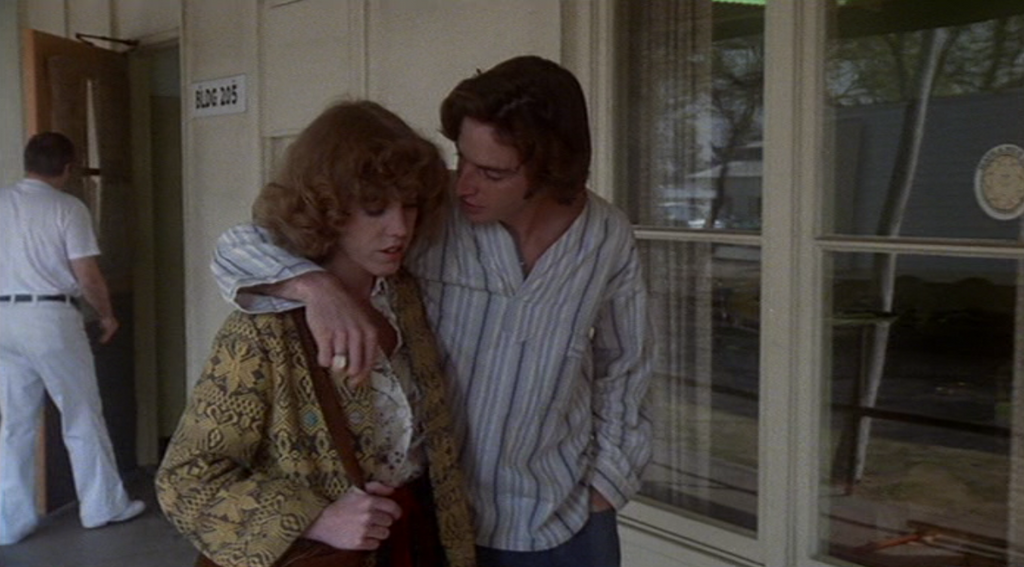 Milford's performance as Vi contributes an essential tenderness to Coming Home, sweetening the sentiment that drives the film, steering it away from either dourness or sourness and toward the hope that Ashby's film seems to so crave.
 The role of Vi -- the bad girl destined to be a really good woman -- is at once limited and also rife with contradictions: Vi's a bold pleasure seeker who desperately craves approval; she's also a lost little girl who with serious mother hen tendencies. As written, Vi (like Stapleton's Pearl) is a woman who makes up for what she lacks in intelligence with extraordinary savvy and intuition. As such, the role of Vi demands a tricksy balance.
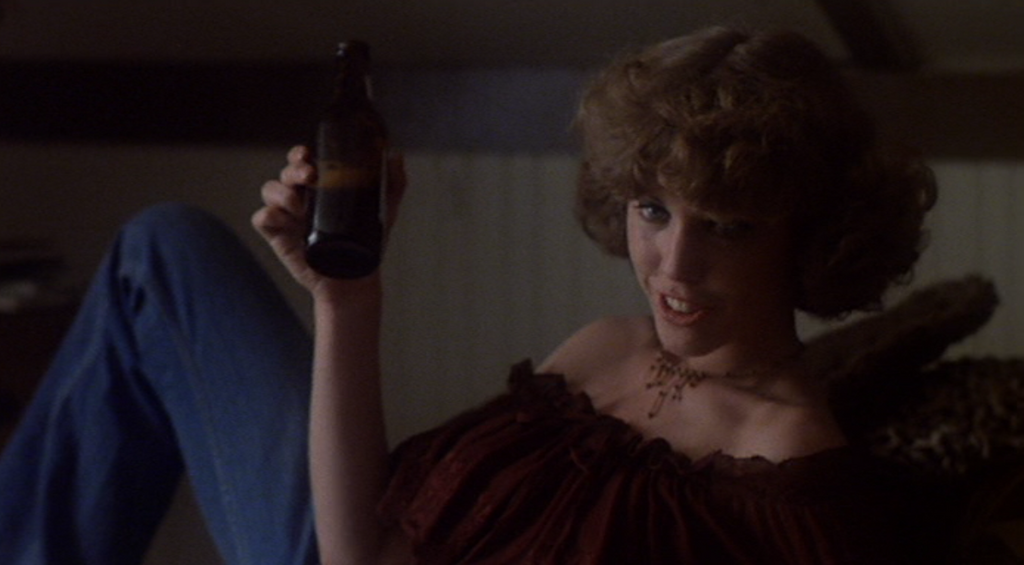 And Milford -- bless her heart -- doesn't really meet the challenge. Milford's Vi doesn't radiate the kind of innate charisma or protean wisdom necessary to justify Fonda's attraction to her as a friend and mentor. Nor does Milford's Vi blaze with the kind of elemental anguish or fury to balance Bruce Dern's incendiary -- and, in terms of construction, complementary -- performance. Simply put, and sadly so, Milford does not hold down her corner of this four character piece.
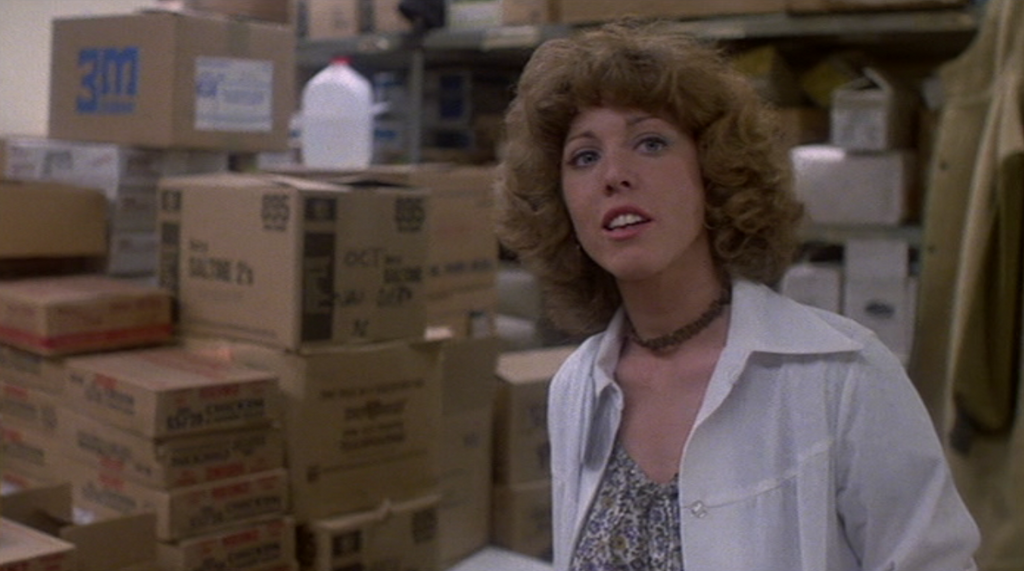 Milford's Vi, for all her acting out, remains a curiously passive and immature presence when the role demands an almost constant, kinetic acuity. (Not only is it tough to remember that Carradine's Bill is Vi's kid brother, but it's nearly impossible to believe that Fonda's Sally would ever follow Vi's lead.) The result? Vi becomes an emotional accessory for Sally, rather than her guiding star. What's worse, Milford's Vi seems always already almost a victim.
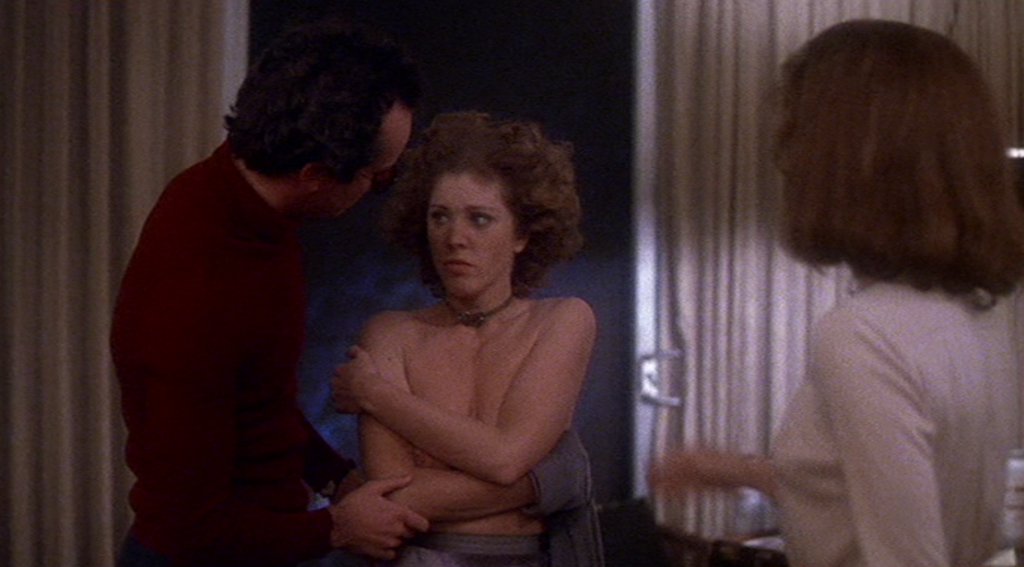 There's a story that circulates about the casting of Coming Home, that Fonda wanted her recent Julia co-star -- an emerging actress named Meryl Streep -- for the role of Vi. It's a pungent legend, mostly because it's suggestive of how substantial Vi might be within the world of Coming Home. Unfortunately, Milford's performance is more negligible than formidable, consistently characterized by vapid listening, shallowly reactive emotional states and (most infuriatingly) glancing away from the camera at essential moments.
 A remarkable role. An appealing actress. A negligible performance.
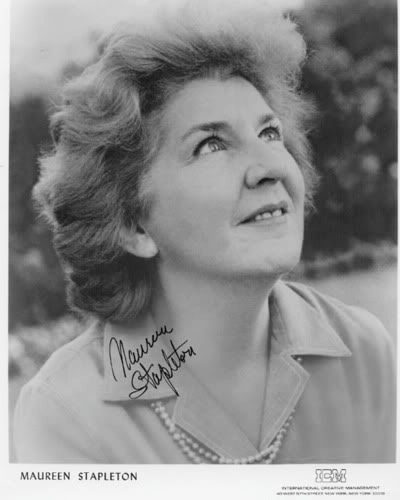
 from MANDATE: The International Magazine About Men.The following (tardy) Supporting Actress Sunday profile revises and slightly expands on a previous treatment of Maureen Stapleton's nominated performance (viewable here).
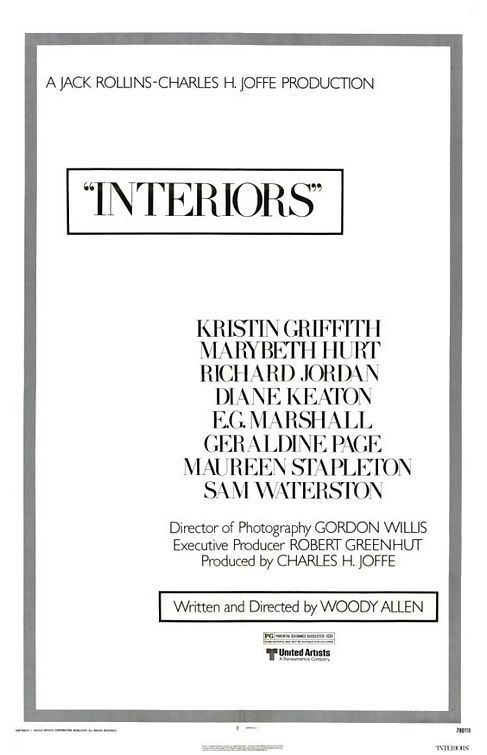
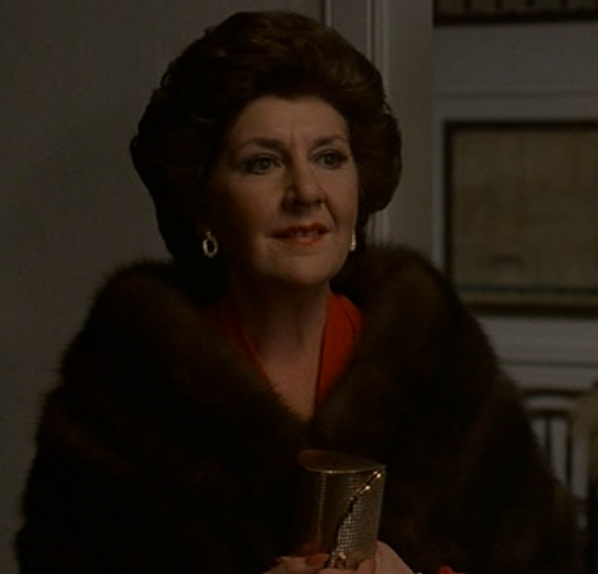 The new "squeeze" of the recently divorced Arthur (E.G. Marshall), Stapleton's Pearl is an affront to everything Arthur's daughters expected of their father and a repudiation of everything represented by their mother. (Geraldine Page, in a Best Actress nominated, mannered shriek of a performance is Interiors's voracious Medea-mother, sacrificing her children, devouring them for the lost love of of their father.) Stapleton's Pearl is something else entirely...
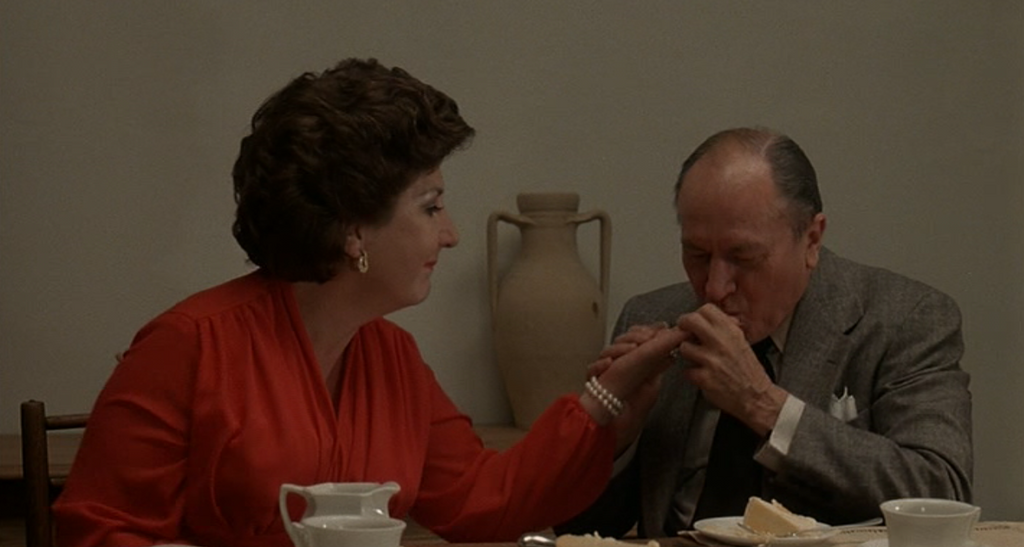 ...a stark contrast that Sarah Vowell describes as:
As Pearl, Stapleton demonstates her uncommon capacity to be palpable on screen; Stapleton's Pearl creates a sense of immediacy, of presentness, that slices through the internalized, emotional caul that so stultifies everyone in Interiors. Indeed, Tropical Storm Pearl blows into this family of the walking wounded -- each of her adult stepdaughters tenderly nurse their emotional scars as evidence of their lifetime of slights and disappointments -- and becomes a cleansing, healing breath of life.“Geraldine Page is all beige this and bland that so her husband divorces her and hooks up with noisy, klutzy Maureen Stapleton, who laughs too loud and smashes pottery and wears a blood red dress to symbolize that she is Alive, Capital A." (Assassination Vacation, 5)
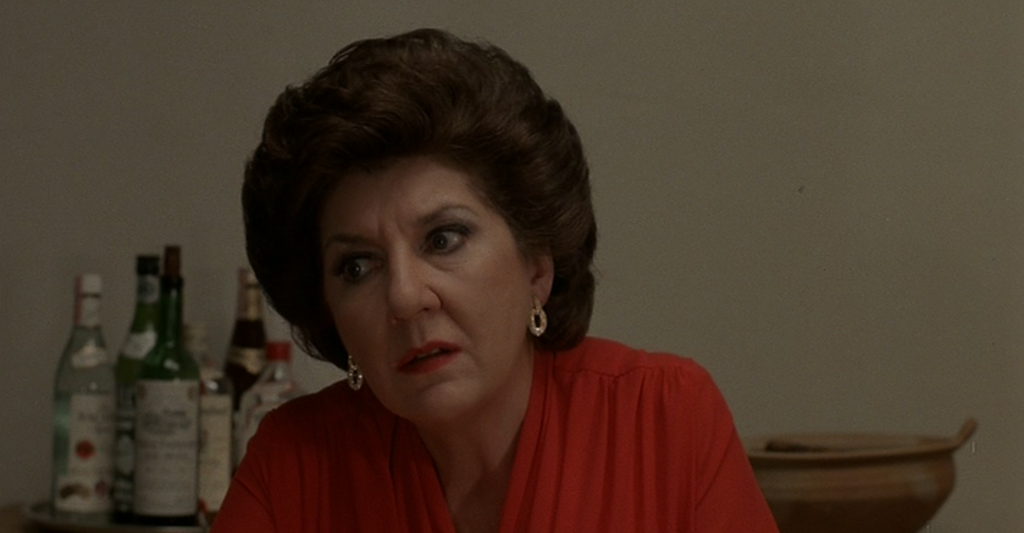 Into this family of intellectuals who argue over plays and architecture, Maureen Stapleton’s Pearl blazes with comedic contrast like the proverbial bull in a china shop (even destroying some heirloom crockery along the way). Throughout, Stapleton's self-deprecating but confident Pearl becomes an astonishing creature, as rare and exotic as a unicorn in this family, as a woman much less concerned with being "right" than she is with embracing her choices with enthusiasm and verve. Stapleton's Pearl heralds the potency of a life fully-lived, proof-positive of the possibility of healing -- and, as such, her arrival tosses the whole family into a fresh disequilibrium.
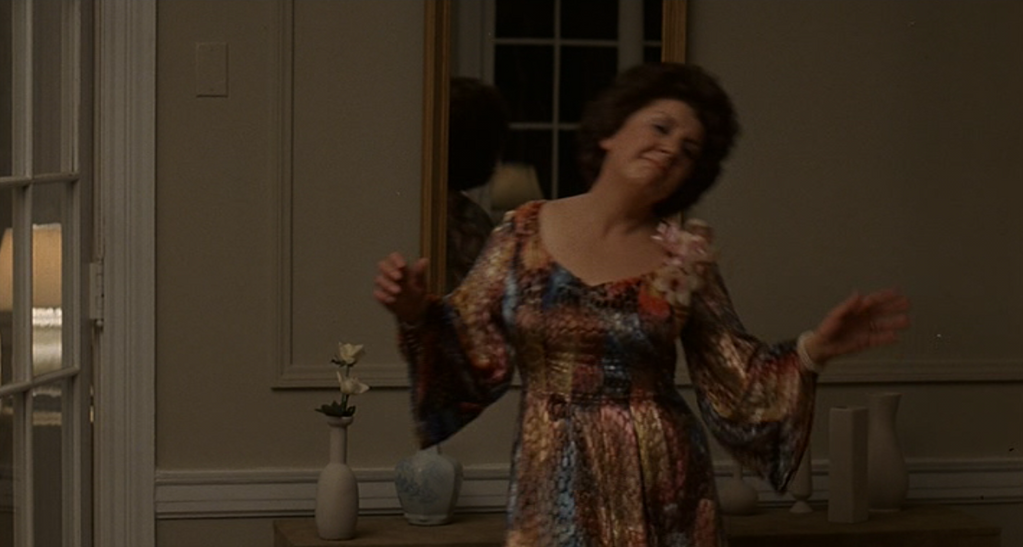 Stapleton's performance as the loose, sloppy Pearl emerges as a marvel of precision. Stapleton shows that Pearl's zest for living isn't so much an act of bravado or denial but the best choice available to this woman. Consider the moment when Mary Beth Hurt's Joey shrieks and calls Pearl an animal. Stapleton's stricken expression communicates (in an electric instant) not only that Pearl's capable of being hurt, but also that she's been hurt before, that -- like her namesake gem -- Pearl's lively luster is the product of grinding life experience.
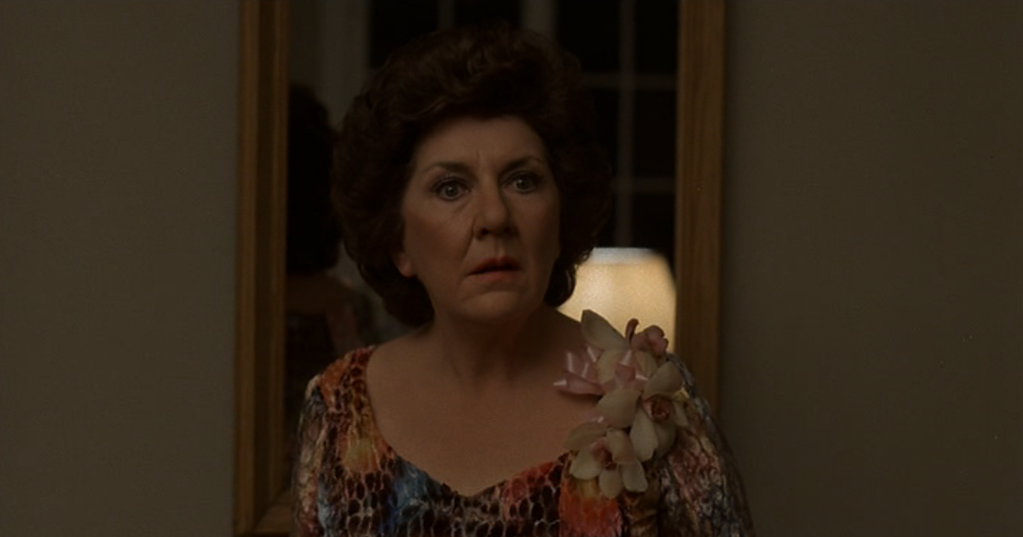 But, in this same moment, Stapleton's expression communicates that Pearl's perhaps the only one to recognize the depth of Joey's hurt, how Pearl's the only one able to hear Joey cry out in deathly pain.
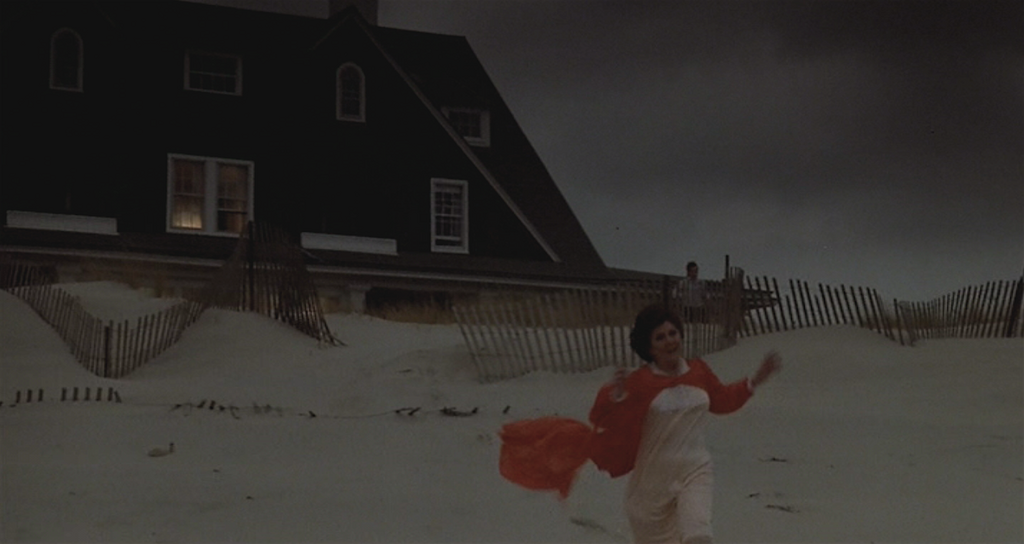 And just as Pearl breathes life into the nearly drowned Joey, so too does Stapleton's performance infuse this odd Woody Allen marvel with a profound and powerful force...
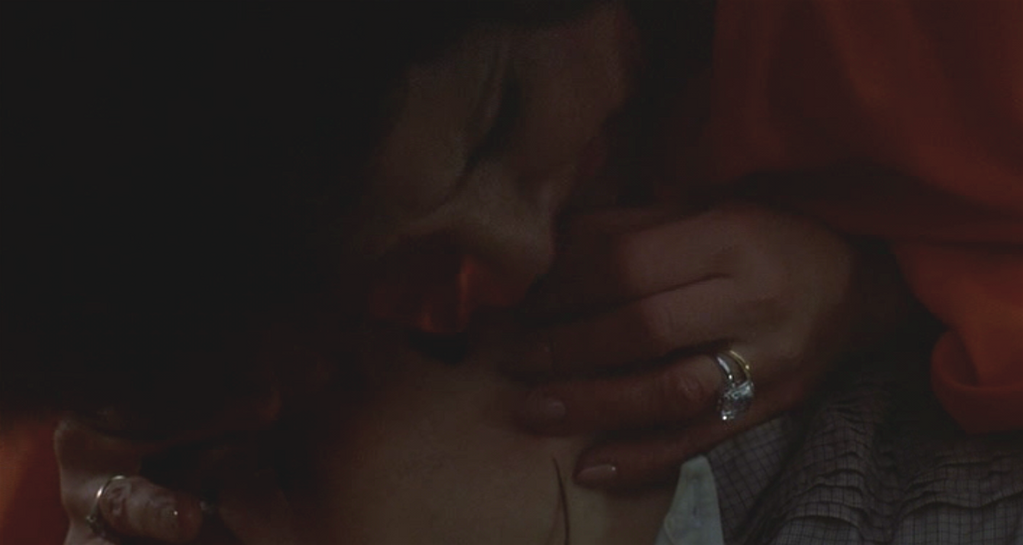 ...investing Interiors with a powerful, strange subtext of humility and gratitude. Indeed, Maureen Stapleton's performance as Pearl in Interiors stands as perhaps StinkyLulu's favorite performance by one of the best actresses ever to thrive while actressing at the edges...
 This post is StinkyLulu's rambling contribution to The Action Heroine Blogathon, instigated and hosted by Nathaniel @ The Film Experience. Be sure to check out the many posts assembled over at Action Heroine Blogathon HQ.
 typically
  a video montage all amped out with some negligible power pop anthem; the scene where the hero does all kinds of crazy pull-ups and curls; the one when he assembles all his guns or knives or whatevers; the one where he pushes, sweating and grimacing, through the physical pain of his previous weaknesses (born through illness, injury, office bound ineffectualness, or incarceration); the one which typically finishes as he straps himself into some kind of elaborate butt-kicking ensemble, regards himself in a reflective object of some kind, before delivering some glib one-liner (which typically reeks of the screenwriter's desperation to craft a pop culture catch phrase)...
 click image for video link
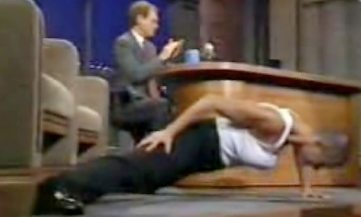 click image for video link
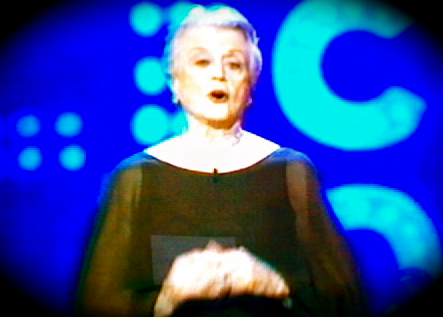 The Tony bug burrowed into StinkyLulu's soul during the big bad 80s, the decade abutting one of the best Tony broadcasts ever (1984) against one of the absolute worst (1985) and during which Angela Lansbury (at the crest of her Murder, She Wrote fame) became the first of a series of hosts brought in to "save" the Tonys' always beleaguered ratings (just like Rosie O'Donnell did a decade later, and Hugh Jackman did a few years after that). Indeed, LaLansbury will, in some ways, forever be the true host of The Tonys in StinkyLulu's Tony-lovin' heart. So, at the outset of Sunday's broadcast, 'twas truly a thrill to hear Miss Angela's resonant proclamation: "Welcome to the 61st Annual Tony Awards!" 'Tis a blend of old-school Broadway verve and my own particular nostalgia, & 'twill likely ever be one of Lu's favorite line-readings ever.
 Jeepers.
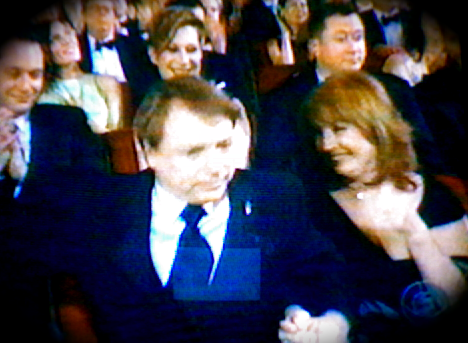 ...I Just Hate You ...For Not Only Were Kiki & Herb Robbed... But So Were We! What oh what would it have been to witness Justin Bond and Kenny Mellman give an acceptance speech on national broadcast television? While David Hyde Pierce's coming out was sweet and elegantly accomplished, I would've must preferred the freaktastic queerness that would have inevitably snuck into the proceedings with Justin Bond on that stage. Ah well. At least you know that the devastating humiliation will provide Kiki excellent fodder for banter and repartee for, oh, forever. (Losing to a wooden puppet? Puh-leez.) But still. StinkyLulu officially registers hate for the Tony voters' insipid predisposition to convention on this one.
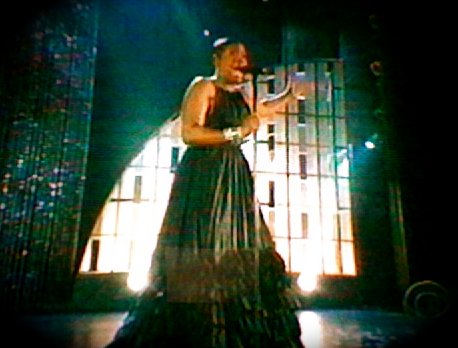 Ya gotta hand it to whoever it was who thought to cast American Idol's Fantasia in The Color Purple. LaChanze's "upset" win last year seemed an important reminder that, as sprawling a piece as it is, the story is really all about Celie and, as such, the musical provides an extraordinary star showcase for a youngish black woman with good pipes and lots of charisma. Fantasia's reviews have been solidly complimentary and her performance last night (somehow "in character" even though she was wearing a gothic wedding cake of a dress) gave an exciting enticement to see the show (even more than last year's LaChanze charmfest). Hey, put Melinda Doolittle in the touring production, why dontcha!
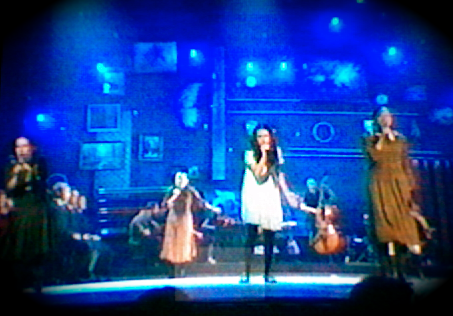 For perhaps the very first time ever, StinkyLulu actually had seen one of the best musical nominees prior to the broadcast. (Not only did StinkyLulu see Spring Awakening on a late January trip to NYC, but Lu subsequently rearranged a lecture course this past semester to incorporate a full day's attention to the new musical and the Wedekind original.) In the intervening months, StinkyLu's been rooting for Spring Awakening's success, while committing the original cast recording to memory. All of which made the medley/montage performed at Sunday's broadcast all the more treatsy. 'Twas excellent to see the female ensemble featured, as much of the media has been fascinated by the boys. '
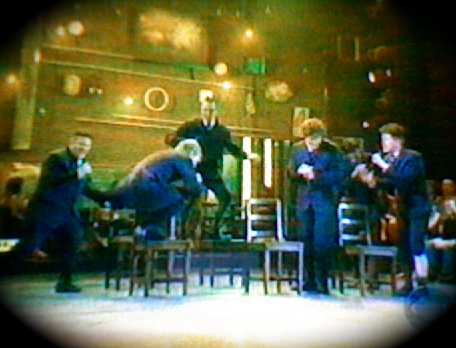 Twas also nifty to be given a glimpse of three separate (and totally different) numbers, melded into a crowd-rousing commercial for Spring Awakening as RENT-redux. (Though 'tis false advertising of sorts. Because, while there is much leaping and some dancing on tables, Spring Awakening has no "La Vie Boheme" -- indeed, there's not a clearly celebratory song in the show. Indeed, while the show matches RENT's power of ensemble feeling, Spring Awakening's intelligence, complexity and emotional sophistication really stomps new circles in the "rock" musical as a form.) But the niftiest aspect of the curiously frankensteined number? The way they "adapted" the profanities to CBS standards and practices -- with some lyrics adapted, with other deleted lyrics created some of the night's most interesting theatre.
 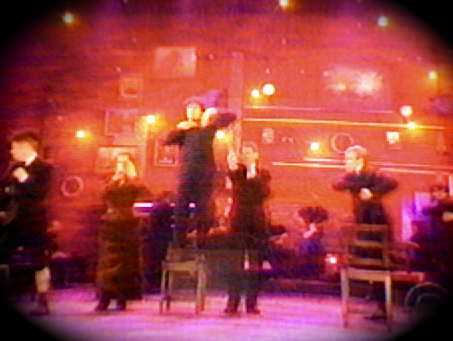 The startling but evocative "gaps" in "Totally F*****" were amplified by additional choreography -- arms crossing in an "x" before the performer's mouth, index finger raised and shushing the lips, hands clasped across mouths -- gestures that both acknowledged the censorious nature of the adjustments while also elaborating upon them in ways totally in tune with the musical's style, tone and message. 'Twas one of those rare occasions in which a performance adapted cruelly for television adeptly communicated the original spirit of the piece, adding surprising elements rather than merely removing the offensive bits...
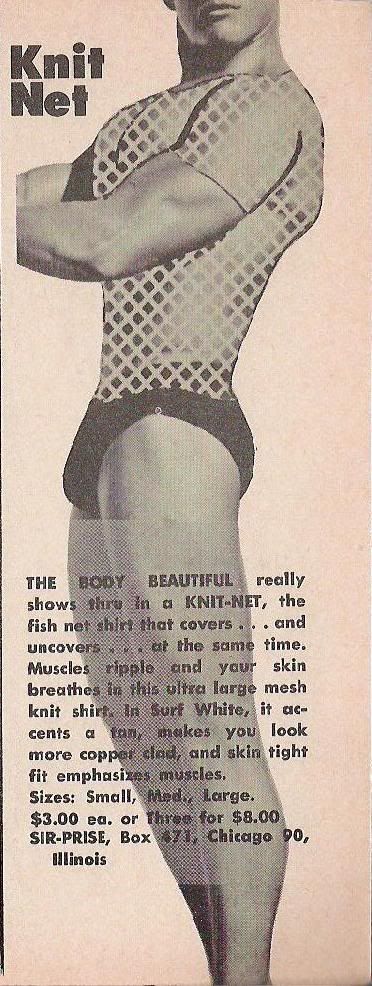 from VIM: The Magazine for Vigorous Living.