
5.31.2009

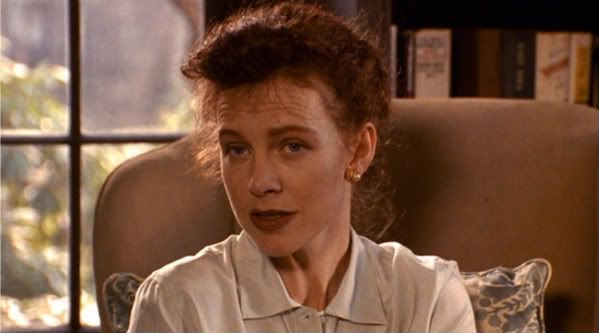
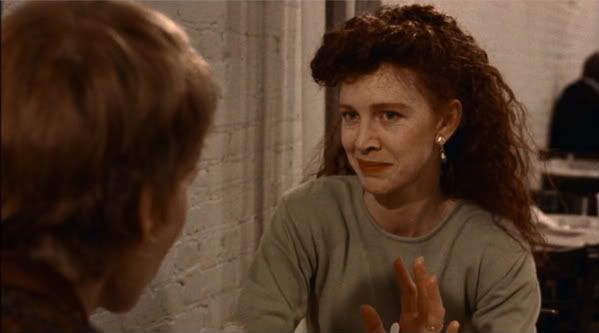
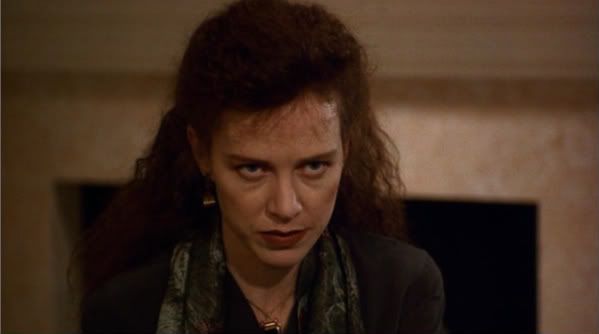
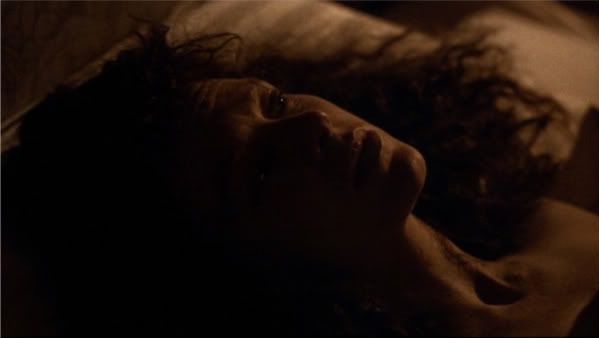
Miranda Richardson in Damage - Supporting Actress Sundays

There's that old saw: "They just don't make them like that anymore." And, when you're talking about the late 1980s and early 1990s trend toward high-end erotic thrillers, you just have to say: "Thank goddess!" It's an era bracketed in some ways by two unusual supporting actress nominations -- Anne Archer in 1987 for Fatal Attraction and the nomination of...
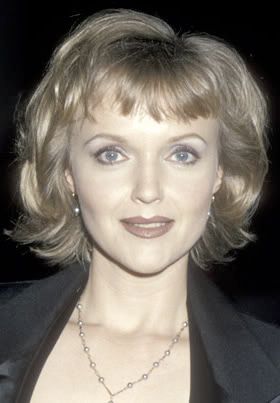
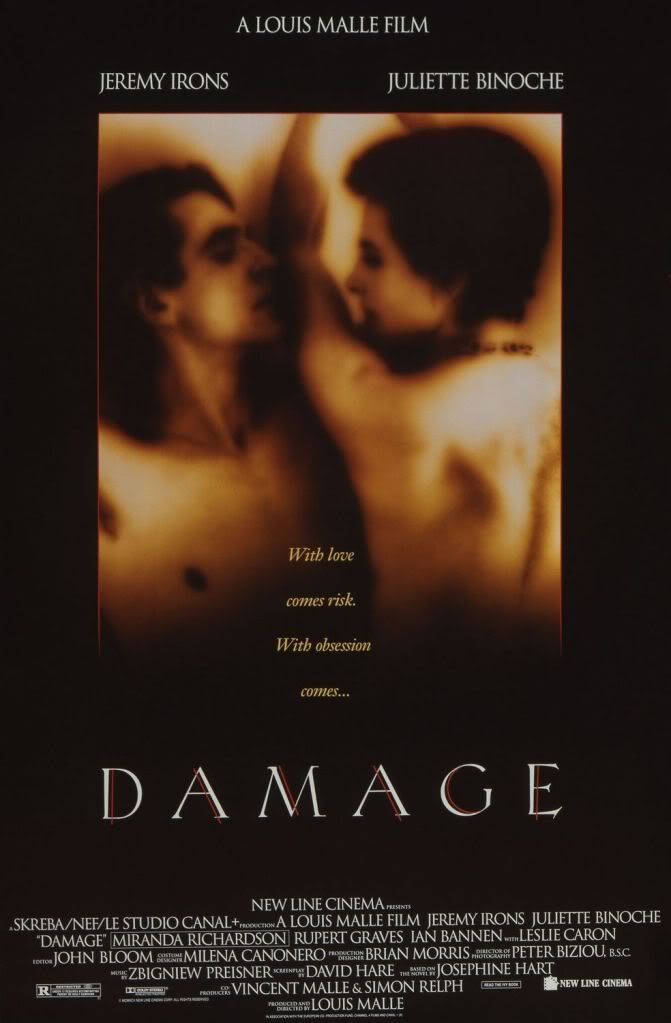
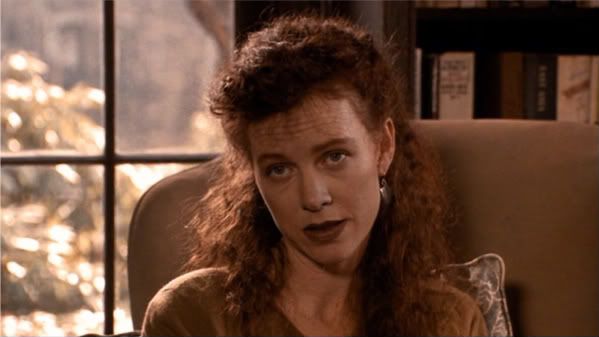
...Miranda Richardson in Damage (1992)
approximately 21 minutes and 40 seconds
20 scenes
roughly 17% of film's total running time
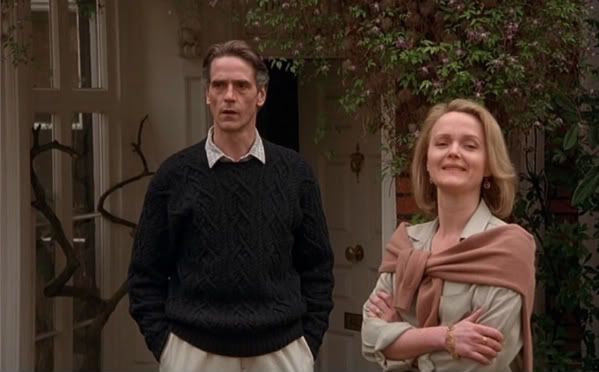
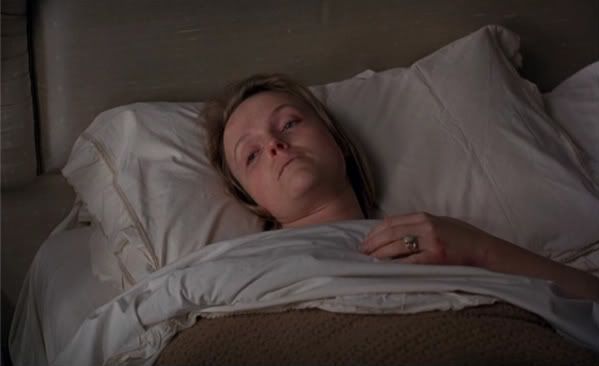
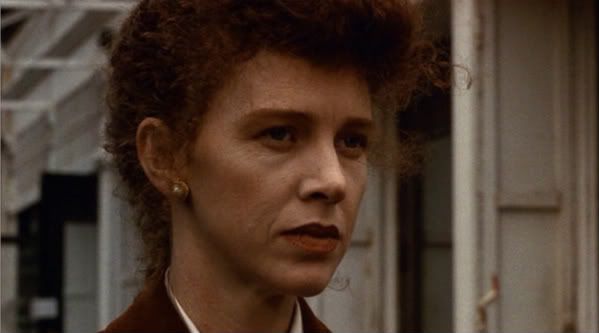
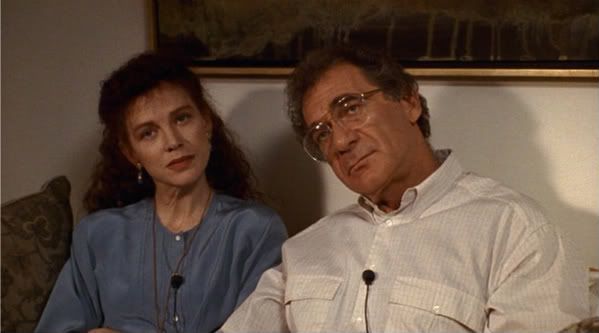
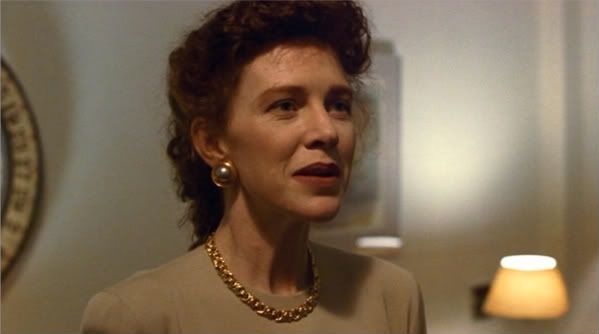
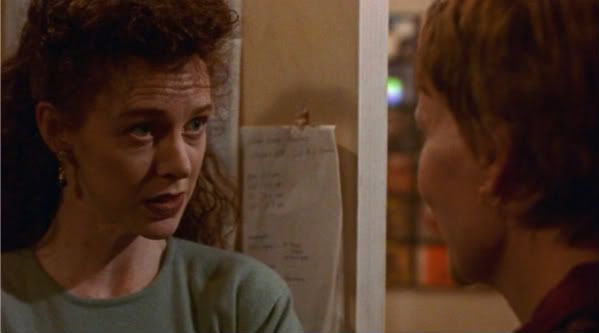
Miranda Richardson plays Ingrid Fleming, the apparently content wife of doctor/politician Stephen (Jeremy Irons in a curiously constipated performance).
Richardson's Ingrid appears by most counts to be adequately happy in her life as a wife and mother.She's devoted to her adult son Martyn (Rupert Graves, a classic example of early 1990s cuteness) and is doing her best to stay patient with her moody teen daughter.
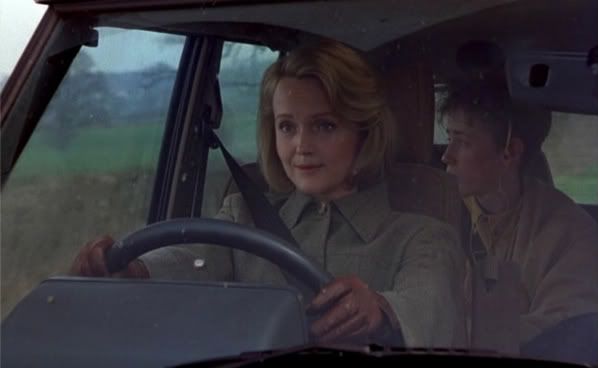
Throughout, Richardson's Ingrid seems utterly confident that she and Stephen are a basically good couple, doing their solid best to balance the complex demands of career and family.
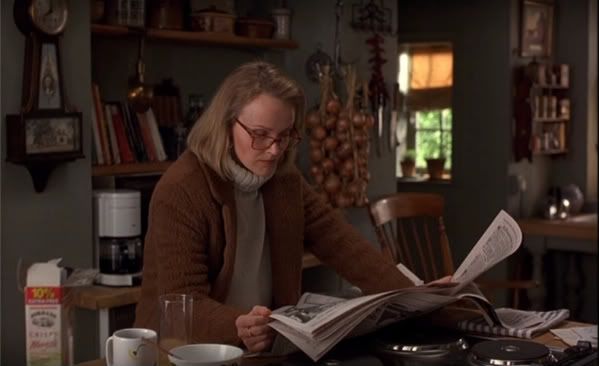
Richardson's Ingrid also appears utterly oblivious to Stephen's mounting obsession with his lover, Anna (a cardboard cutout purported to be Juliette Binoche).
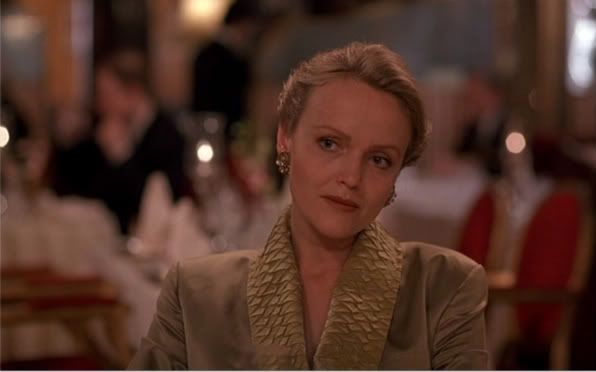
This is not to say that Richardson's Ingrid likes Anna -- who (in addition to being her husband's secret lover) also happens to be Martyn's new flame. To the contrary, Richardson carefully scores the many ways that Ingrid mistrusts "something" about Anna and also how Ingrid forges past such concerns as she does her best to support her beloved son.
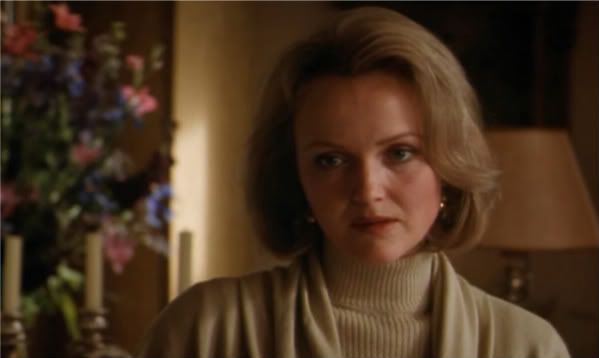
Likewise, the fact that Ingrid remains oblivious to Stephen's affair is also not to say that she's unaware that something's off about Stephen.
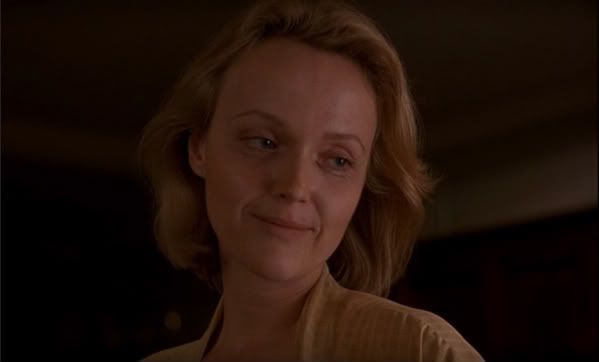
Indeed, Richardson gracefully notes the many ways Ingrid recognizes her husband's distraction, preoccupation and odd behavior, suggesting that Ingrid's aware of the distance growing between her and her husband even as she struggles (sometimes half-heartedly) to do something about it.
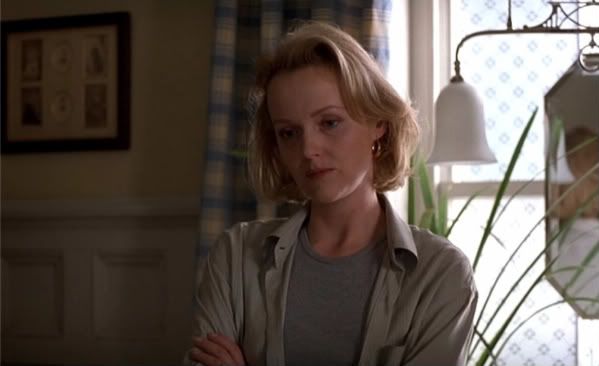
In so doing, Richardson's characterization of Ingrid deftly demonstrates how an intelligent, intuitive woman might "not see" her husband's conspicuous infidelity as it also provides a compelling foundation for the emotional fireworks that are to follow.
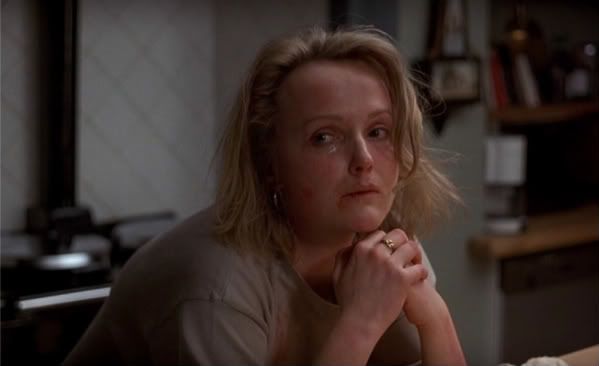
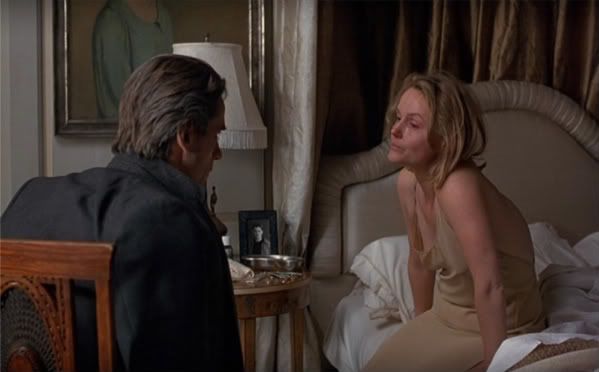
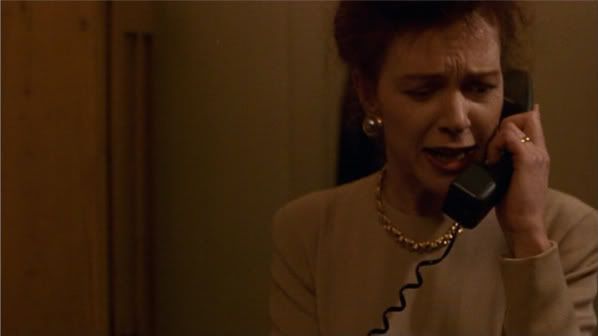
Because this is a narrative about the "damage" wrought by erotic obsession, Stephen's affair with Anna is discovered in an especially tragic way. The tragedy of the revelation provides the impetus for a series of scenes in which Ingrid must travel a startling gamut of emotions.
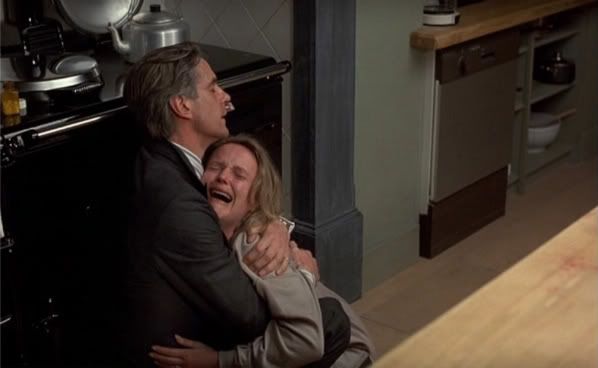
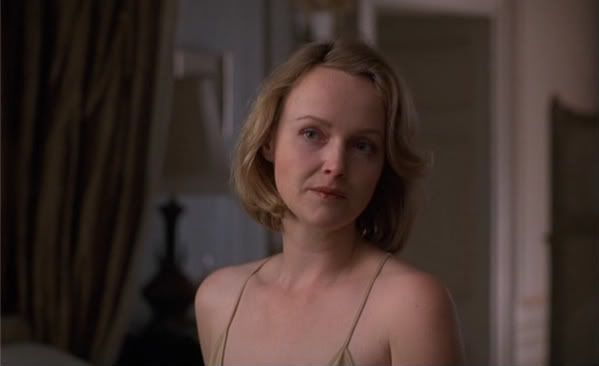
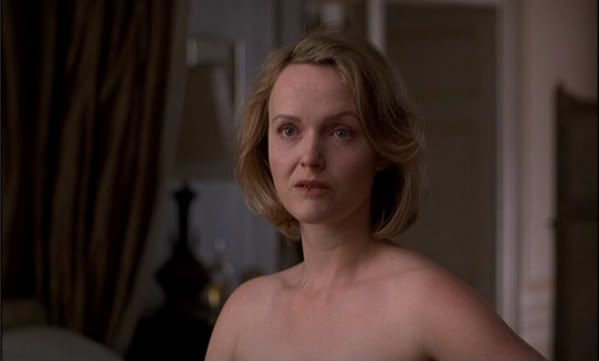
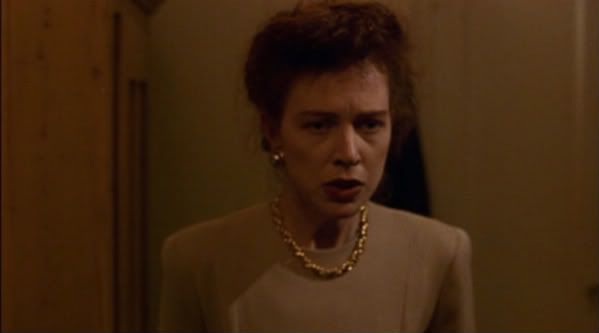
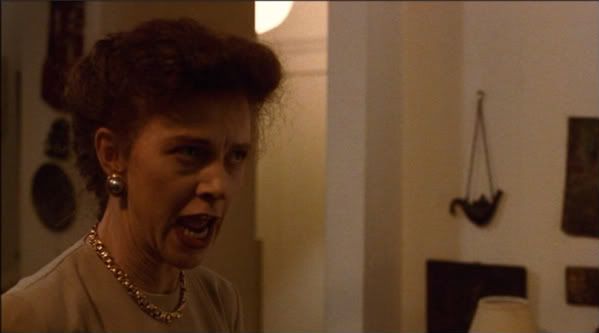
This series of scenes marks very different moments in a life-changing 24-hours for Ingrid but, because director Louis Malle strings them together in a nearly continuous 5-minute block of time, the sequence becomes one concentrated portrait of Ingrid's devastation. And Miranda Richardson nails each emotional note on the Kubler-Ross spectrum: anger...
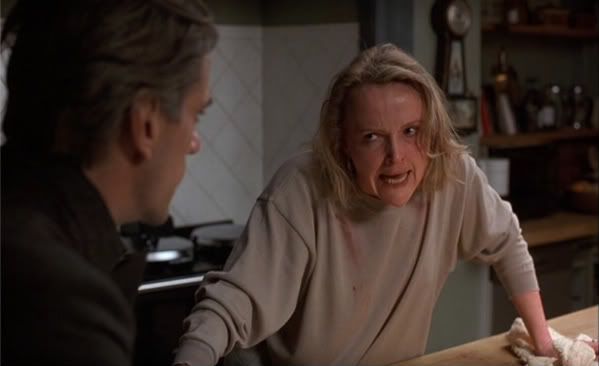
depression...
denial...
bargaining...
acceptance.
All told, Miranda Richardson's performance as Ingrid provides a sympathetic anchor for this meandering, misanthropic film. At her most galvanic, she's extraordinary -- intelligent, layered, nuanced -- elsewhere, though, Richardson's performance remains confined by the sketchiness of the screenplay's treatment of the character. Indeed, if anything, the performance suffers because Richardson did almost too perfect a job of coloring "inside" the broad outlines of this wan stock character. The nuance, the texture, the shading -- all top-notch. But I'm left with little real sense of who this woman is beyond her narrative function as the sympathetic, wounded wife.
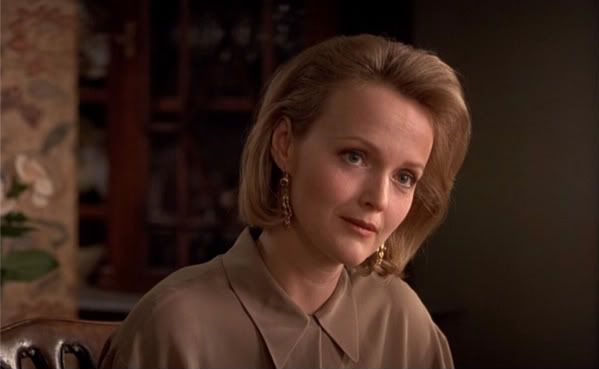
That said, Miranda Richardson's work in the role of Ingrid -- especially her wrenching scenes of grief and betrayal -- provides the singular note of grace within this otherwise graceless film.

Vanessa Redrave in Howards End (1992) - Supporting Actress Sundays

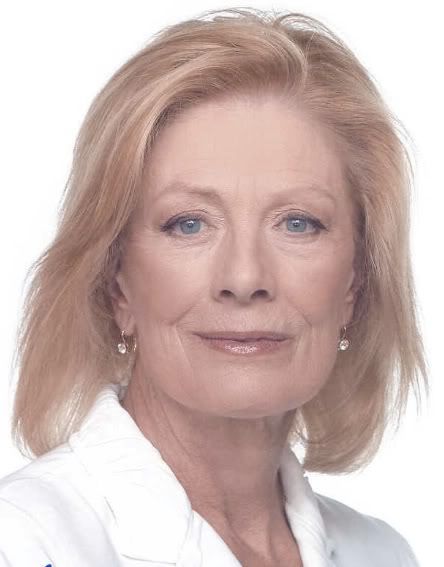
There are few pleasures for me greater than seeing a familiar performer break from type as they essay a role. Of course, when we think of type and acting, we often think in terms of typecasting and stock characters -- when a certain performer becomes so associated with a familiar kinds of role that they get "stuck." For supporting actresses, this can be both a blessing and a curse (just think of Thelma Ritter, crafting vastly different characterizations yet somehow confined to delivering variations on a theme). But there's another sort of "type" that's harder to break, when a performer elicits such a specific feeling in both performance and persona that it's almost more delicious when they play against that grain. (This is, to my mind, what Glenn Close did when she broke out of her Supporting Actress mold of generous supermothers to her Best Actress nominations for those monstrous gorgons. Perhaps another example? Just imagine Dolly Parton as a deglammed villain...) Yes, there's something thrilling when a familiar performer breaks from type in that way. Like when one of the most forceful, articulate and strident activist presences in contemporary cinema takes on the role of a sweet, duty-bound and deferential wife and mother. As stunt casting, it can be shocking and thrilling but, when the performance is really good to boot, something marvelous can happen, as it does with...

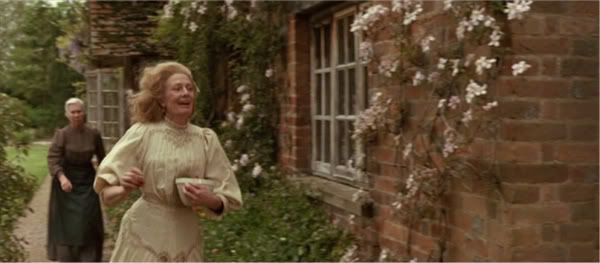
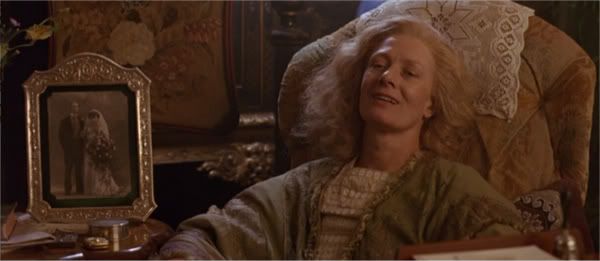
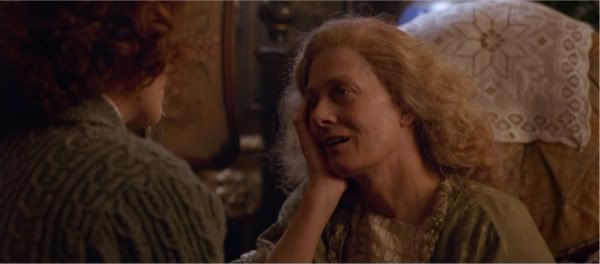
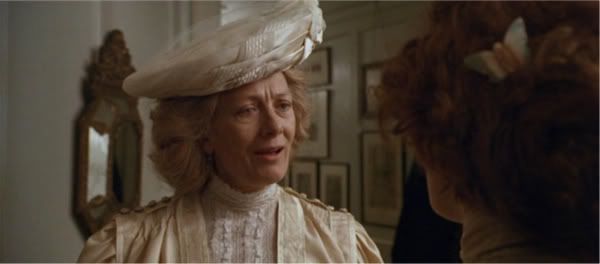
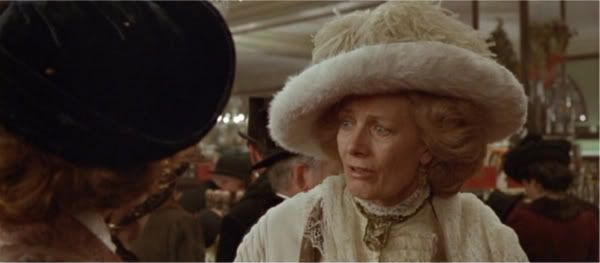
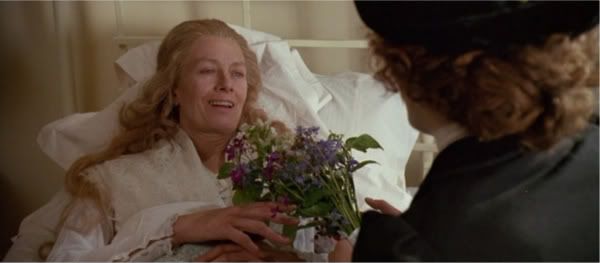
...Vanessa Redgrave in Howards End (1992)
approximately 17 minutes and 27 seconds
13 scenes
roughly 12% of film's total running time
Vanessa Redgrave plays Mrs. Ruth Wilcox, the matriarch of a wealthy British clan who understands herself as a proper British wife and mother, deferential to social proprieties of privilege.
Yet, Redgrave's Ruth holds one thing dearer than all else: her familial home of Howards End.
In quick flashes, we see how the way of living at Howards End elicits the young woman who yet lives inside the aging matron.
But Redgrave's Ruth is no longer young. A barely acknowledged, mysterious illness has caused Ruth to reckon her own mortality and Redgrave's Ruth finds herself unexpectedly "brooding" about a rapidly transforming Britain and what future it might hold for her beloved Howards End.
At this moment, Redgrave's Ruth encounters Meg Schlegel, an unmarried woman of not dissimilar social standing but of much diminished economic security (Emma Thompson giving an utterly winning portrait of a complex character).
Meg's chattiness and generosity of spirit prove a refreshing diversion for Ruth, and the bluestocking Meg and the blue-blooded Ruth soon become unlikely but devoted friends.
In friendship with Meg, Redgrave's Ruth blossoms -- expressing opinions, discovering a kind of assertiveness, trusting the validity of her private hopes -- and Redgrave's Ruth is grateful for Meg's witness of this self-discovery.
Ruth's sincere gratitude to Meg finds its expression in Ruth's final gesture, an assertive act of incredible generosity which her family must dismiss as fraudulent and uncharacteristic of the Ruth Wilcox (they thought) they knew. This misunderstanding of Ruth's last wish impels the action and drama of the narrative that unfolds within Howards End and Ruth's presence haunts the action of the film as complication upon complication delays the fulfillment of Ruth's plans. For this narrative to work (and thanks to Ruth Prawer Jhambvala's screenplay it does), Ruth Wilcox must be both a vulnerably human figure at the same time that she's ghostly, ethereal, almost supernatural.
In a masterful bit of actressing, Vanessa Redgrave strikes a sublime balance in her characterization of Ruth Wilcox. Here, Vanessa Redgrave crafts a lovely portrait of a loving, deferential woman basically untroubled by the social norms that so confine her. Perhaps most impressive is just how deftly Redgrave tempers her own formidable and electrifying force of personality and channels it into a vivid depiction of Ruth's intrinsic integrity. Redgrave's Ruth emerges as a really nice lady who's about to die and who only wants to be sure of one thing before she goes. And Redgrave makes a smart, masterful choice to convey Ruth's reality: simple complexity. At nearly every moment, Redgrave's Ruth embodies an elemental paradox -- she's both young and old, or ill and vital, or shy and assertive, or selfish and selfless -- and, through it all, Redgrave conveys Ruth's human complexity with a transcendent, humane simplicity.
Through Redgrave's forceful simplicity, we may not learn much about Ruth Wilcox but we emerge, along with Thompson's Meg, certain that Ruth Wilcox is a formidable spirit not to be taken for granted, nor to be dismissed easily. And it's that spirit that becomes the clarifying filter guides us through the rest of the emotionally intricate story. In short, Redgrave performance is stunningly crafted work, that of an artisan and an artist. (A fact made all the more impressive by the circumstances surrounding the filming of her scenes.)
Utterly ethereal yet utterly real. A stunning, masterful bit of actressing.

5.26.2009

COMING ATTRACTIONS - Supporting Actress Smackdown - 1992

Thanks once again to ALEX (of Alex in Movieland & My Latest Oscar Film) we can whet our actressexual appetites for this weekend's Supporting Actress Smackdown, featuring the nominated Supporting Actresses for 1992.
click image to be routed to video

The Smackdown's scheduled to post at noon or thereabouts this Sunday (U.S. time). See you there!
And if you're looking for something to do between now and Sunday, check out the action (especially the "Supporting Actor Survey") and leave lots of comments at the site of one of our newest Smackdowners, MovieMania.

5.24.2009

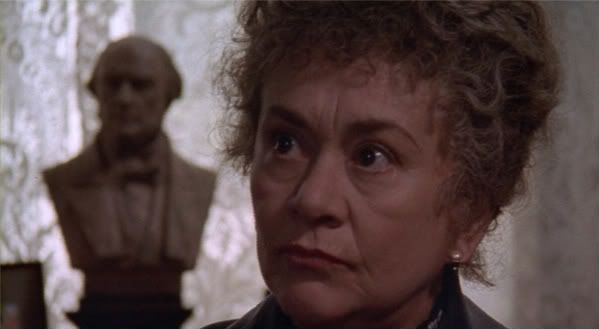
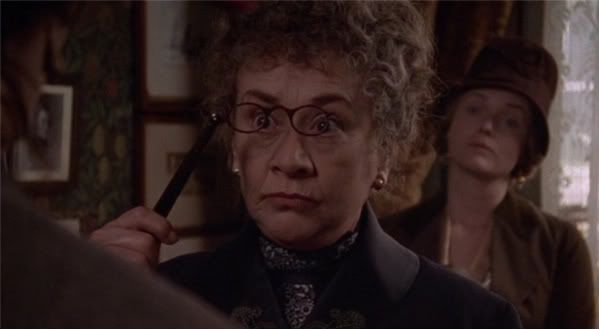
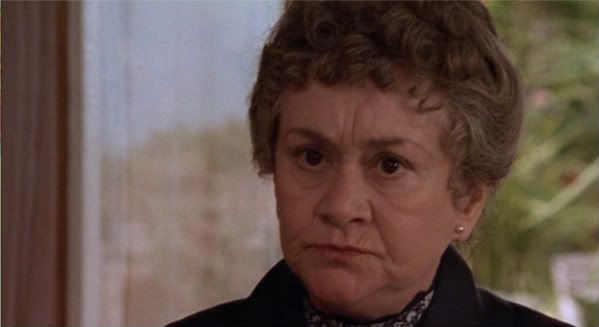
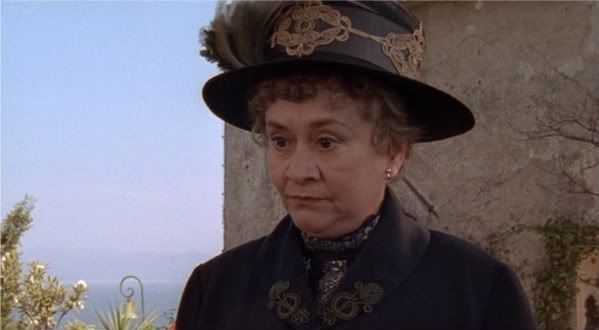
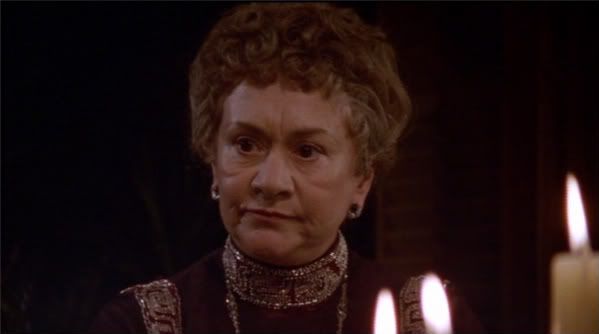
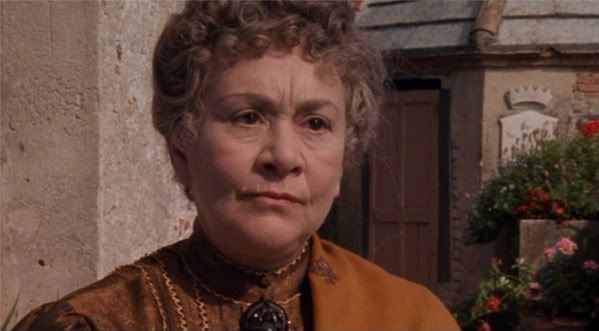
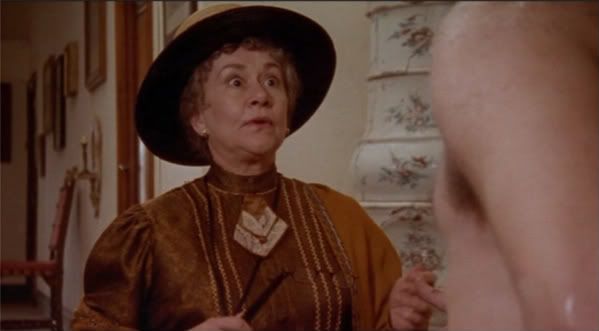
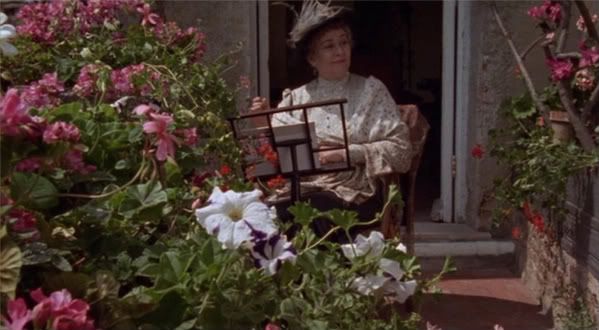
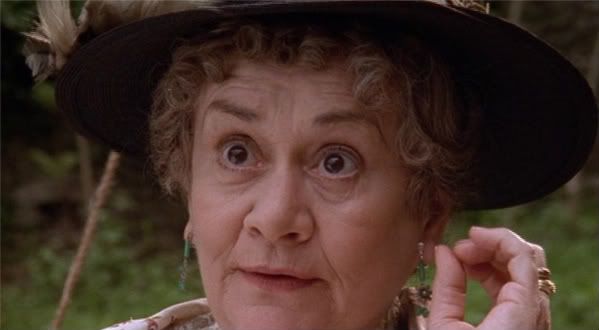
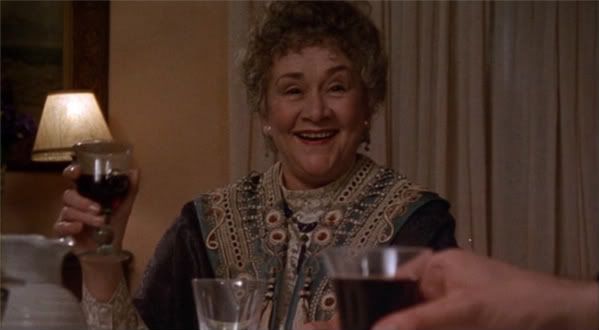
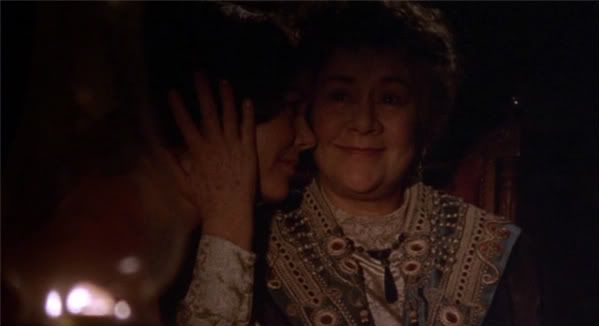
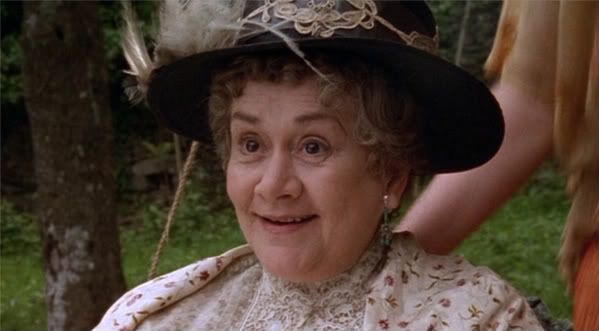
Joan Plowright in Enchanted April (1992) - Supporting Actress Sundays

One of the stubbornest habits among the nominators of Best Supporting Actresses is the tendency to get all excited about an elder actress's "return" to cinematic prominence later in life. Indeed, a cursory survey of the category discerns the names of some of the most glittering leading ladies of stage and screen -- Sylvia Sidney, Una Merkel, Marjorie Rambeau, Eva La Gallienne, Ann Sothern, Lauren Bacall, Gloria Stuart -- receiving their only nods from Oscar late in life. I must say, I've never exactly minded this particular brand of Oscar nostalgia but it can make for some curious nominations for (especially in the context of the larger career) some unremarkable work. But even unremarkable work from a great actress can be pretty darn good, as is the case with...

...Joan Plowright in Enchanted April (1992)
approximately 23 minutes and 35 seconds
19 scenes
roughly 25% of film's total running time
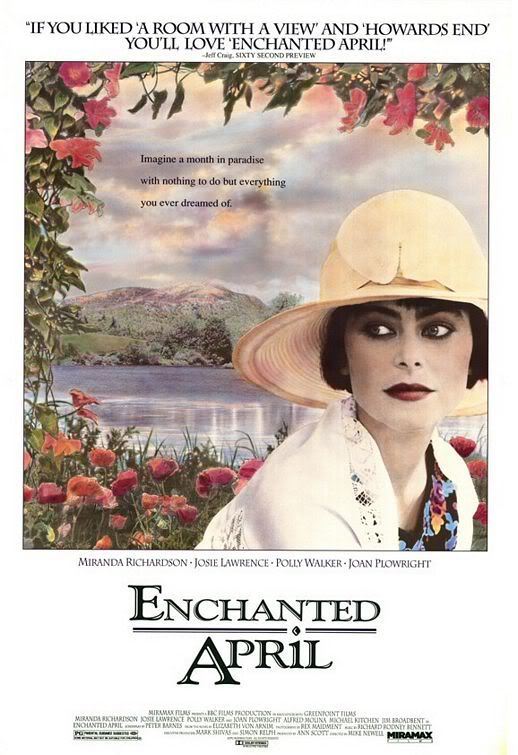
Joan Plowright plays Mrs. Fisher, an intimidating widow who answers the advertisement placed by Lotty and Rose (Josie Lawrence and Miranda Richardson, respectively), two miserable British wives seeking fellow travelers for a month's stay in a castle on the Italian shore.
Plowright's Mrs. Fisher is, quite simply, insufferable. Indeed, at nearly every moment, Plowright's Mrs. Fisher reveals herself to be either...
a pedantic prig, or...
a crabby curmudgeon, or...
a selfish simp, or...
some exhausting combination of all of the above. Yet, Plowright's skill in the role, however, derives from her capacity to texture each of these awful affects with a punctuating glimpse of Mrs. Fisher's essential, defining loneliness. Mrs. Fisher is desperately melancholy, unhappy in her life and yet uncertain or unwilling to make any meaningful change in how she lives her life.
Of course, even Plowright's Mrs. Fisher falls sway to the "enchantment" that is central conceit of this benign little piece (a made-for-tv movie in the UK, repackaged as a theatrical release in one of the earliest years of Mirmax's British obsession). As the magic of this Italian estate finds its way into the hearts of the four vacationing women, they each find themselves newly capable of freeing themselves of their rigid views about men and relationships and, thus, opening themselves to experiencing the joys of life.
And among all the transformations, that experienced by Plowright's Mrs. Fisher is perhaps the most conspicuous.
To her credit, though, in this light romantic fable, Plowright offers a simple -- but never glib -- depiction of Mrs. Fisher's emotional reawakening. As she develops this fairly simplistic character arc, Plowright permits Mrs. Fisher to be a coherent character. It might be easier to, as Josie Lawrence does, approach this character as an ugly ugly caterpillar becoming a pretty pretty butterfly.
Plowright, however, adopts a more nuanced approach to the characterization. Indeed, what I most admire about Plowright's performance is how her Mrs. Fisher does not become a different person at all, just a much nicer and happier version of who she was all along.
In Plowright's performance, Mrs. Fisher emerges as a woman who, through the course of events in the narrative, chooses to use her formidable powers of wit, personality and intelligence for good rather than for evil. And in so doing, Plowright's Mrs. Fisher emerges as the person most transformed by her "enchanted" April in Italy.
Plowright deftly develops a substantial emotional foundation for Mrs. Fisher, one which subtly amplifies the emotional impact of the fanciful romantic reverie narrated by the film. The character is an "old-school" Supporting Actress type -- the sort that might have, in an earlier era, been played by Maria Ouspenskaya, Edna May Oliver or Dame May Whitty -- and Plowright's performance offers a deftly humanizing spin on this utterly conventional character.
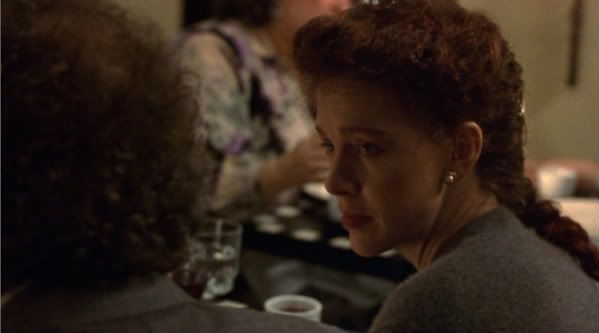
Plowright's peformance marks a subtle accomplishment in a largely unsubtle film.
5.18.2009

If You're a LAMB...
Thanks!
StinkyLulu's been nominated in the category of "Best Running Feature" (for Supporting Actress Sundays). Even though Supporting Actress Sundays is the LONGEST running feature among the nominees, I suspect it will remain "honor just being nominated" due to the heavyhitters amongst my competition. (Just call me the Maria Ouspenskaya of The Lammys.) But, if you're a LAMB, I do hope you'll consider voting for little ole Lulu. And, if you're not a LAMB, I do hope you've got another prize ready to bestow. (Cash is always nice.)

PS: If you DO vote, be sure to support the "Friends of StinkyLulu" among the nominees -- She Blogged by Night, Final Girl, and Valley Dreamin'.

5.17.2009

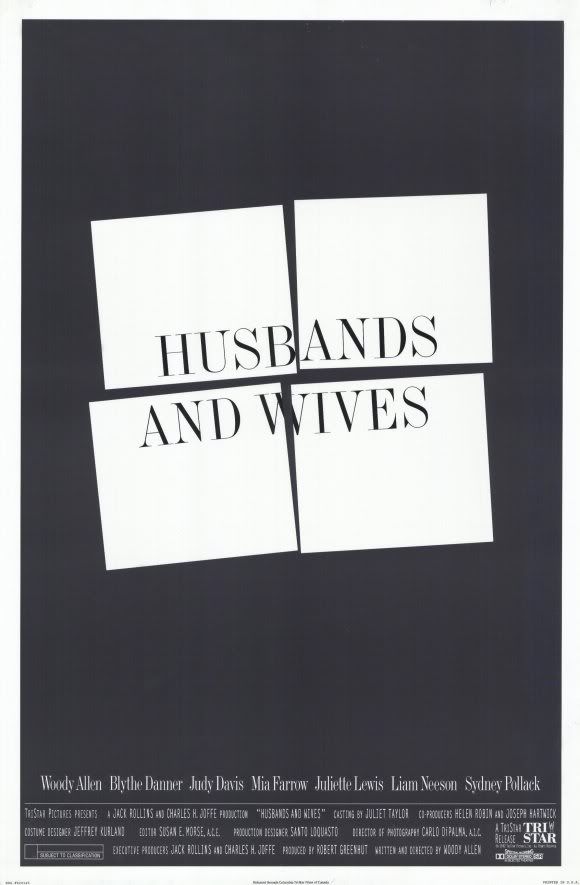
Judy Davis in Husbands and Wives - Supporting Actress Sundays

At this point in my journey through the Supporting Actress archive, I find that I'm becoming very interested in the notion of "stock character" types -- which sorts of characters seem to make recurring appearances among the nominated performances for Best Supporting Actress. And this week, I've hit upon one of the most compelling (and esoteric) of such stock characters, one developed almost entirely within the ouevre of the single director who is only surpassed by William Wyler in the number Supporting Actress nominations to emerge from his films. Of course, I'm talking about Woody Allen and the "stock character" is one brilliantly and instructively performed by...

...Judy Davis in Husbands and Wives (1992)
approximately 32 minutes and 41 seconds
20 scenes
roughly 30% of film's total running time
Judy Davis plays Sally, the most strident of the dissatisfied wives in Woody Allen's acerbic (and pre-SoonYi) portrait of marital malaise.
The character of Sally is a familiar Woody Allen construct: a woman (often, but not always, of a certain age) who has it all -- looks, brains, talent, wit -- who is deeply, desolately unhappy. This Woody Allen "stock female character" is defined both by her desperate loneliness and by her private gnawing certainty that she has been cheated of some undefined something that is her due. This particular "Allen woman" might be debilitatingly neurotic (think Gerladine Page in Interiors), anxiously manipulative (think Mia Farrow in pretty much anything Allen directed her in after Hannah) or charismatically erotic (think Penélope Cruz in Vicky Christina Barcelona) -- but this Allen woman is always bitter, sad and possessed of a vicious tongue. And -- most importantly -- the actresses inhabiting these brilliant, beleaguered women routinely deliver some of the most spectacular actressing in the ouevre of Woody Allen as the filmmaker stands back to watch these women let these eviscerating verbal barbs fly.
And rarely has this particular Woody Allen female stock character been performed with such full-throated confidence as Judy Davis does in the role of Sally.
When Davis's Sally announces that she and her husband of nearly 25 years will be separating, she does so with the obliquely self-satisfied verve of a novelist announcing the sale of movie rights, or a parent proclaiming their offspring's acceptance to Harvard. (Of course, we later learn that Sally thought herself to be the one who had settled in her marriage, that something better surely awaited her.)
When, however, she realizes that her marriage had been the only thing keeping her devastating loneliness at a safe remove, and that her husband has apparently found happiness with another while she remains alone, Davis's Sally soldiers on, guns-ablazing -- unconcerned with casualties left behind in her scorched earth strategy of complete vengeance.
Davis's Sally is perhaps most remarkable among Allen's difficult women for her utter lack of apology.
Davis permits the character's self-absorption to be total, self-ratifying, an end unto itself. She does not flutter with self-consciousness, or implode from the weight of her own angst.
Rather, Davis's Sally is solely concerned with maintaining the formidable edifice of her own ego (and blithely oblivious to whatever collateral damage she might cause) -- and why shouldn't she be? She's worth it! (She's a fox, not a hedgehog!)
I love that Davis's full-throated delivery transforms what might have been throwaway barbs into ballistic missiles. For Davis's Sally, the act of judging others comes as naturally as the act of breathing and -- in some ways -- is more essential than eating. As a result, Sally's sideways insults amplify both the character's grandiosity (as when she rants about Mahler not knowing when to stop) and her interpersonal tonedeafness (her articulate disdain for pretty much anything her date professes to admire). As a result, Davis's Sally is not nearly as pathetic as other iterations fo this Woody Allen stock character. (She is, however, a lot more obnoxious -- emphasis on the noxious.)
Yet, as Allen and Davis are both careful to communicate, Sally's obnoxiousness is part of her powerful appeal, as men fall this way and that over themselves in pursuit of Davis's Sally. Some men retreat (like the unknowing coworker Paul who stands helplessly as Davis rants and rages on the phone with her ex). Others unwittingly pursue (like the lovestruck Michael [played here by an ideally hunky Liam Neeson] who has no idea how outmatched he -- a hedgehog -- is by Sally, a fox.). But these unsuspecting men prove to be merely obstacles in Sally's path as she pursues her single-minded goal: to prove her husband wrong for wanting anyone but her.
And unlike most of these particular Allen women, Davis's Sally is victorious in her pursuit. Her estranged husband returns and, for Sally, this is a victory to savor.
I especially admire how deftly Davis maneuvers the primal and the polite in her performance, quickly revealing (and quickly concealing) the character's primal need/s in glimpses that sometimes last mere milliseconds.
Moreover, Judy Davis shows us this emotional foundation for Sally's generally awful behavior without ever excusing it. Davis's Sally is NOT -- deep in her heart of hearts -- a "good" person (she's actually sort of awful) and Davis shows that...gloriously.
All told, Davis is consistently spellbinding in the role. The movie becomes most alive when she's onscreen. And she somehow makes the most overtly obnoxious character on the screen also the most likable.
Judy Davis's performance as Sally proves to be a provocative, memorable and delightful performance of one of Allen's signature "difficult" women.