Showing posts with label 5 Stinky Thoughts. Show all posts

3.25.2009

It's All About Sex?, or Thought #3 of StinkyLulu's 5 Stinky Thoughts on West Side Story (2009)

This post is the second in my multi-part mini-treatise regarding the current Broadway production of West Side Story at The Palace Theatre in New York City. What I had hoped would be a quick overview of my reactions to the production soon morphed into something more substantial -- or, if not substantial, then too BIG for a single post. So, I've elected to spread my "5 Stinky Thoughts on West Side Story (2009)" across this week...


Thought #3: It's All about Sex?

One of the more striking features of the 2009 West Side Story is its relative sexual frankness. Indeed, librettist (and director of the current production) Arthur Laurents has been telling pretty much anyone who'll listen that West Side Story is "all about sex." (Exhibit A, B.) Not gangs, not racism, not love -- SEX. Now, I don't know that I disagree. It's always been a thrill to see The Jets and The Sharks be so athletic and so balletic and the fun of Anita derives in no small part from her sexual confidence ("You forget I'm in Ameríca!"). The original 1957 production was, by some accounts, something of a cult hit among gay men of the era, not because of the proto-pride anthem "Somewhere," but because of all the young (mostly gay) dancers wearing tight jeans. But in this production, the sexually exuberant Laurents amplifies the sexual currents within the show into something like an overall concept. In the 2009 version, there's little doubt that Tony and Maria are horny for each other. As Laurents himself notes, they can barely get through their balcony duet because they can't keep their hands off each other. Comparably, it's clear that Tony and Maria are having sex "during" the "Somewhere Ballet" and that their sexual connection is the foundation for their belief in a better world. Indeed, it seems to me that Laurents's frank and celebratory interest in sex marks this production's most notable departures from more conventional productions (even, I daresay, more than the addition of Spanish lyrics and incidental dialogue).
While I get it that the sexuality is absolutely essential in West Side Story, and while I get it that Laurents and Robbins landed at nearly opposite ends of the sexual liberation spectrum, I wonder if Laurents's exuberant amplification in this production is entirely effective. Please don't misunderstand: I agree that -- especially with regard to Tony/Maria -- the sexual frankness proves productive in clarifying the characters's motives. However, in this production, it's the other sex stuff that I found odd, discordant, even distracting. My biggest beef came in one of the production's most substantial dialogue changes: GladHand's speech introducing the "Get Together Dance," in which he endeavors -- with ostensibly comic incompetence -- to speak bilingually about the importance of abstinence to the assembled teens. The addition of this material seems to me to be part of Laurents's general intervention in this production, his oddly quaint insistence that teenagers have sex and its a bad idea to pretend that they don't. However, in the particular case of Glad Hand's "abstinence" speech, the changes feel like ahistorical editorializations. (Historically, the discourse of abstinence was not popularly applied to sex education efforts until well after such programs were introduced in the 1970s; the kind of "settlement house" extension work done by GladHand in the 1950s operated from a premise of "sexual hygiene" in which things like chaperoned dances encouraged "appropriate" social interaction. The idea was that, left to their own devices, kids would "get busy" so better to keep them busy with more appropriate activities.) As such, GladHand's abstinencia scene just felt off-kilter, both historically and conceptually. Comparably, I found it startling that the incidental dialogue added for this production included The Sharks's shouting of "maricón" -- as well as a handful of other obscenities en español -- without comparable trashtalk from The Jets. Where the 2009 Jets DID get their filth on was in the realm of wordless gestures -- crotch-grabbing mostly, though also including one especially strange wiener wagging moment and an incongruously trashy costume for Graziella. All of which felt tacky, like high schoolers pretending to be sexually "dangerous." Finally, I found it fascinating that what has long felt to me to be the queerest moment in the piece (the brief scene between A-rab and BabyJohn after the Rumble, in which the two young men find comfort with one another) is played with a near absence of genuine feeling (perhaps due to Kyle Coffman's twitchy performance as A-rab).
I could go on, and I might, especially about Laurents's reinterpretation of the "Somewhere" ballet as an earthtone idyll (I kept waiting for someone to start singing "I Believe That Children Are Our Future") and how Laurents's emphasis on sexuality mark the most substantial shifts in the production, not the addition of the bits of Spanish here and there. And, admittedly, I find it strange that I'm levying this charge ("Laurents put too much sex in West Side Story!"). But when I track the actual ways that this production is a "revisal" of the original, it seems to me that the sex changes are fundamental while the Spanish stuff is almost incidental and, quite possibly, the sex changes might choreograph the most significant of the production's accumulation of missteps.

3.23.2009

How Do You Solve a Problem Like Maria?, or Thought #2 of StinkyLulu's 5 Stinky Thoughts on West Side Story (2009)

This post is the second in my multi-part mini-treatise regarding the current Broadway production of West Side Story at The Palace Theatre in New York City. What I had hoped would be a quick overview of my reactions to the production soon morphed into something more substantial -- or, if not substantial, then too BIG for a single post. So, I've elected to spread my "5 Stinky Thoughts on West Side Story (2009)" across this week...

Thought #2: How do you solve a problem like Maria?

The casting of the role of Maria (and, although to a lesser extent, Tony) has historically proven the musical's greatest challenge, both in terms of theatrical effectiveness and cultural authenticity. Maria must be young, pretty and able to sing really really high -- while also spanning an emotional arc that spans from delightful innocence to erotic abandon to devastating grief. The way I see it, the musical (especially in its stage variant) begins with The Jets as its collective protagonist but ends Maria as its primary tragic figure. Act I is about The Jets; Act 2 is about Maria -- dovetailing tragedies of love and belonging. In this production, Josephine Scaglione -- an Argentinan stage pro -- is utterly competent in the role, charismatic and endearing. Yet, in ways I found surprising, Scaglione's performance replicates one of the greatest flaws in Natalie Wood's generally underrated screen performance: Scaglione's Maria never seems to belong among the Shark girls. Yes, I know she's "fresh off the boat" and all that, but part of Maria's significance as a heroine is that everyone adores her...Anita, Bernardo, Chino and -- most fatefully -- Tony. In this production, Scaglione brings what I've long thought to be an "opera problem" to the role: she's animatedly "in" every scene with the Shark girls but she's never quite "of" the moment. I must confess, too, that I find it very strange that this "revisal" -- the animating "alibi" of which is the impulse toward a greater measure cultural "authenticity" regarding The Sharks -- also repeated what has been a critical problem in every major production: finding the "whitest" Maria possible. Put another way -- while her Act1 dress is supposed to be white, NOTHING in the script says Maria herself needs to be fair-skinned.
Yet in the role's four major interpretations, the role of Maria has been historically portrayed by lightskinned beauties (Carol Lawrence '57, Natalie Wood '61, Jossie De Guzman '80, and Josefina Scaglione '09). Indeed, Jossie De Guzman -- the only Puerto Rican performer to essay the role in a Broadway or Hollywood production -- was critiqued by some activists for being "too European" in appearance for the role. This production's Maria, Josefina Scaglione, is -- like Carol Lawrence (the 1957 Maria) -- of Italian heritage, and already I'm seeing the stirrings of U.S. Latino resentment against the casting of an actress from Argentina in the role (for a panoply of reasons too complex to cover here). Scaglione also is the only major Maria to have blue eyes, causing me to wonder if the oft-pilloried Natalie Wood might actually be the "darkest" of the major Marias.
The problem I see here is no fault in Scaglione's performance, but a residual inclination to cast Maria in a way that exempts her -- or makes her "different" from -- the rest of The Sharks, a predisposition inaugurated in the 1957 production and replicated in most major productions since. What's seems most unfortunate here is that the 2009 "revisal" of West Side Story seems to have been an ideal opportunity to "experiment" a little with the conventional casting protocols for the principal character of Maria, a chance to "officially" reinvent not only what these characters sound like but also what they might look like. Scaglione's fine in the role but it's difficult for me not to see her casting as confirmation of the production's simple-minded vision of latinidad. (And don't even get me started on that rose tapestry hanging as backdrop during "Siento Hermosa/I Feel Pretty.")

3.22.2009

"Prologue" and "Siento Cansado", or The First 2 of StinkyLulu's 5 Stinky Thoughts on West Side Story (2009)

This post is the first in what appears to be emerging as a mini-treatise regarding the current Broadway production of West Side Story at The Palace Theatre in New York City. What I had hoped would be a quick overview of my reactions to the production soon morphed into something more substantial -- or, if not substantial, then too BIG for a single post. So, I've elected to spread my "5 Stinky Thoughts on West Side Story (2009)" over the next several days...


PROLOGUE: When You're a Fan...
For reasons that are not at all rational, I often feel that West Side Story, in all its variants, is "mine." The musical has occupied its own corner of obsession in my mind since I first screened it one summer afternoon when I was not quite 12 and visiting my grandmother's house (it was the afternoon movie). Moreover, I've spent much of the last decade researching both the original stage musical and its Oscar-winning film version, as well as the projects myriad productions, adaptations and revivals in the half-century since. My primary scholarly interest in West Side Story can be discerned from the working title of my work on it: "How the Sharks Became Puerto Rican." (In this work, I explicate how the almost accidental choice to make the rival gang Latino has become one of the musical's most significant cultural legacies.) Along the way, I've accumulated a pile of factoids, which I've done my best to cross check and verify, and which I've strung and restrung into various iterations of my understanding of how West Side Story came -- and continues to come -- into being. So, when it was announced that the musical's librettist Arthur Laurents would be directing a newly bilingual Broadway revival of the show, I knew it was necessary that I see the "revisal" of this show. Which I did, last week, in one of its final preview performances. What follows include some of my preliminary thoughts on the production, informed of course by my ongoing interest in the musical's peculiar formal, social and racial history.

Thought #1: Siento Cansado.
As the evening approached, everyone asked: are you excited? And with each query, I was somewhat surprised to notice that I wasn't. Perhaps I was tempering my expectations? Perhaps I was concerned by my early, underwhelming glimpses of the production? (Exhibit A) At the same time, I felt mostly very glad to finally have the opportunity to see this show in its Broadway habitat. (West Side Story has been on Broadway only twice before: for the several years of its original run in the late 1950s and for the several months of its first revival in the 1980s. I had also missed the restaging of most of the musical numbers as part of the 1989 anthology musical, Jerome Robbins' Broadway.) Only as curtain time approached, did I really begin to become giddy. Yet, once the show began, with the electrifying genius of "Prologue," I noted the aspect of the production that would come to define my experience of the evening: everything seemed oddly muffled. I first noticed this physically -- kinesthetically -- as the physical confrontations between The Jets and The Sharks seemed almost tamped down, squeezed and compressed. At first I thought it might have been because of the relatively small stage, that there wasn't a lot of room for the dancers to move but -- as more songs and scenes followed this opening dance -- I realized there was a consistency to the correction. At every turn, I noted the curious lack of a final punch. Extensions seemed oddly curtailed. Arms seemed rarely to extend to their full reach. Notes were swallowed. Lines tossed off. Scenic transitions lagged. Everything felt a little muffled. And I could almost always hear everyone (though, notably, I struggled to make sense of the unscripted incidental dialogue throughout the piece, whether they were spoken in Spanish or not.) But muffled, rather, in an emotional sense. My appreciation of this piece has long derived from its incredible sense of emotional immediacy. But, here, there was a kind of distance, a manner of remove that I found odd, even stultifying. The charismatic Karen Olivo (as Anita) felt glib, her dance work in both "Dance at the Gym" and "America" seeming a little wan and unrealized, like she was "marking" rather than performing each number. The exuberant athleticism of Cody Green (as Riff) felt oddly restrained, his capacity for great height, for great reach, seemingly held back. Matt Cavenaugh (as Tony) sang gloriously but almost always at a different tempo than the orchestra and Josephine Scaglione (as Maria) glowed, princess-like, in her own little bubble.
All told, I felt the production to be competent but curiously fuzzy, lacking an essentially energizing clarity and precision which ended up blunting the emotional intensity of the entire piece.

Come back on Monday for the 2nd installment of
StinkyLulu's 5 Stinky Thoughts on West Side Story (2009):
"How Do You Solve A Problem Like Maria?"

4.22.2008

5 Stinky Thoughts on Near Dark (1987) - Final Girl's Film Club

Forgive my tardiness as StinkyLulu offers the following "5 Stinky Thoughts" as my contribution to the monthly FILM CLUB instigated by Final Girl.

click image to be routed to video

Thought #1: Near Missing Near Dark.
Not sure how it happened but,
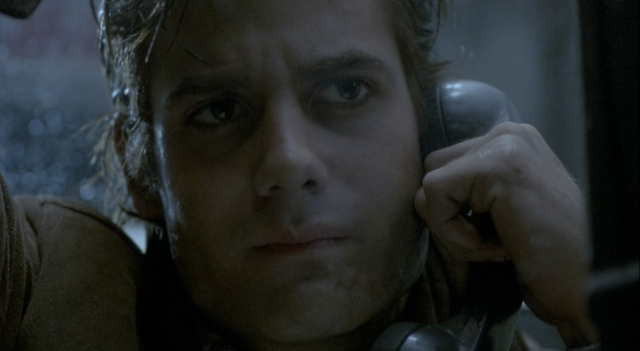
somehow, despite a near miss or two, I had totally missed Near Dark -- 'til now. So, for Film Club, I arrived to Kathryn Bigelow's film as a complete neophyte, knowing little about it beyond two superficial details. One: people seem to treasure this indie horror flick. Two: it features what is possibly Bill Paxton's most revered performance. But I truly expected Near Dark to be a smartish splatter-tacular featuring hip vampires as outsider anti-heroes. I also anticipated there to be a "bad blood" riff, a nightmare -- circa 1987 -- of the deadly consequences of exchanging blood products. I certainly did not expect a genre-defying existential romance featuring a cowboy with pronounced vampiric tendencies and a heightened ethical sense. Indeed, Near Dark defied my every expectation at nearly every turn. Thanks, Final Girl, for the prompt to screen this smart, scary, sensitive tale -- 'tis an unusually haunting (and hilarious) film.

Thought #2: The Family That Feeds Together.
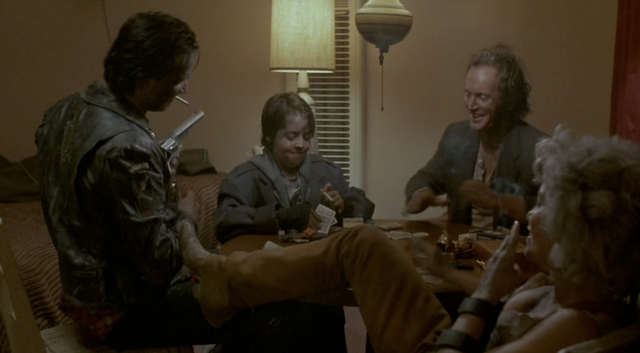
Vampire stories are so well suited to AIDS allegories -- the deadly desires, the survivor's guilt, the blood products -- that I tend to casually disregard the possibilities of vampires as addicts. (I think my preferred monsters for addiction narratives are probably werewolves.) Yet, even as Near Dark savvily dodges any AIDS implications in this mid1980s riff on the vampire story, it subtly explores the dimension of another cultural crisis circa 1987: active addiction as a family disease. Perhaps it's hard to recall now but it's worth noting that 'twas not until crack began ravaging certain communities in the mid- to later 1980s that the notion of a family of addicts started circulating in the popular consciousness. (Previous notions of addiction as a family disease had a single addict threatening the health and security of the nuclear family.) The idea of relatives "turning" each other onto a shared drug of choice was comparatively new in 1987, a narrative trope reflecting something that happened banally with alcohol from forever, stealthily with heroin in the 1970s, with crack more rapidly and more visibly in the 1980s, and most extensively with meth in the 1990s and the 2000s. But this intergenerational vision of a mother, pre-teen and grandfather all using the same drug at the same time became a particular, new vision of horror in this period and Near Dark explicates it with an evocative ambiguity that remains compelling.

Thought #3: Who Knew Bill Paxton Could Be So F'n Brilliant?

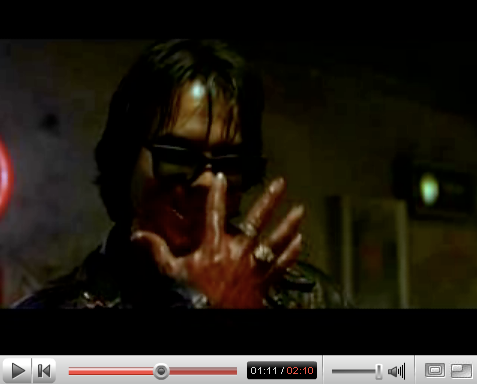
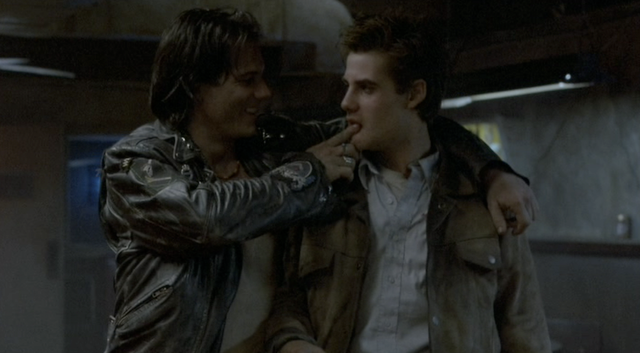
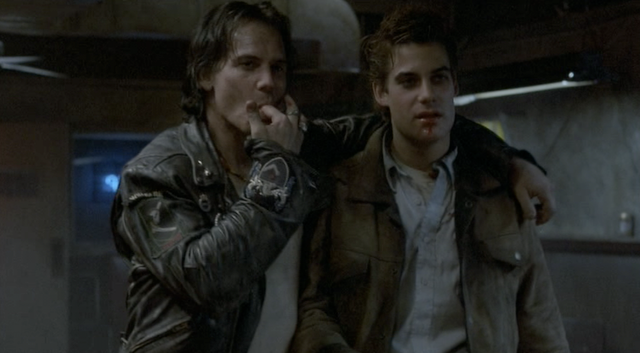
As the big bad Severen, Bill Paxton delivers what is certainly one of his most memorable and accomplished performances. Paxton approaches Severen as a person who just happens to be a supernatural monster, and this simple choice enriches the film in delightful and terrifying ways, while also elevating the character's stock horror bits with poignant hilarity. Paxton's Severen is all unfettered id (albeit the id of a mucho macho man who happens to drink blood with plans to live forever). But rather than tapping into Severen's rage or angst or arrogance, Paxton taps into the character's glee, recalibrating Severen as a creature who wants to party all the time, every night, for all eternity -- and beware to any who kill his buzz. This is, I suspect, what makes the scene in the biker bar so thrilling. Paxton could have played it all predatory and terrorizing, but instead he plays it as an incredibly tasteless prank, a "let's play with our food before we eat it" kind of stunt. Further, Paxton plays the scene as if he's taking his little brother to a cathouse. For Severen it becomes an opportunity to have a good time showing off a little while also initiating his young ward into this new mode of manhood. The result is a strangely charged scene of homosocial preening and masculine autoerotics. Yes, it's a gruesome terrifying scene, but one made curiously and complexly thrilling by Paxton's excellent work.

Thought #4: Behold the Dewy Doofus.
Among actors of his generation, Adrian Pasdar must have one of the most distinctive heads. The pronounced brow, the sleepily deep set eyes, the supple lips, the cartoonish jaw -- Pasdar is both immediately recognizable yet curiously generic, both sooo 1987 and timelessly ideal for morally ambiguous characters. Here, Pasdar's tasked with playing a zen romantic hero, a sensitive new age family guy capable of kicking ass but who's defined by his adamant refusal to become a killer. Pasdar possesses a dewy doofiness that permits the actor to participate effectively in what emerges as one of the film's most interesting subversions (the reversal of the date rape scenario). Pasdar maintains our empathy even when, all at once, he's both the aggressor and the victim. In just such a way, Pasdar conveys all the character's essential paradoxes: he's the horndog with a heart of gold; he's the kid who's neither especially smart nor particularly dim but who nonetheless somehow figures his own way out of an eternal conundrum; and, most essentially, he's the tender-hearted vampire. The role draws well upon Adrian Pasdar's peculiar gifts and the actor's actually fairly excellent in the part (and pretty dreamy besides).

Thought #5: Detox for the Undead.
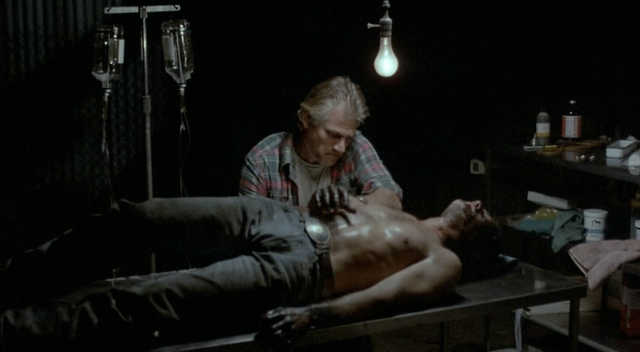
One of the things that remains fascinating about this film to me is that, aside from its use of unspecified vampirism as an overt metaphor for an unspecified addiction, Near Dark also stands as a recovery narrative: a narrative depicting one addict's ability to "recover" from his addiction and (most especially) spread the possibility of such healing to others similarly afflicted. The film's climactic transfusion sequences are essentially detox scenes and, when Caleb brings the hope of a cure to his beloved Mae, it's like an AA story -- one addict helping another to find a new way to a new life without their drug of choice. There're no rehabs or 12steps in Near Dark but the film does stand out as a fascinating riff on the cinematic genre of addiction/rehab narratives, whether intentionally or not, with Caleb standing as proof that there is a way out of the (near) darkness.

So, lovely reader, do you have your own Near Dark experiences?

11.19.2007

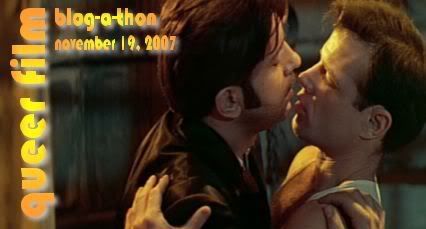
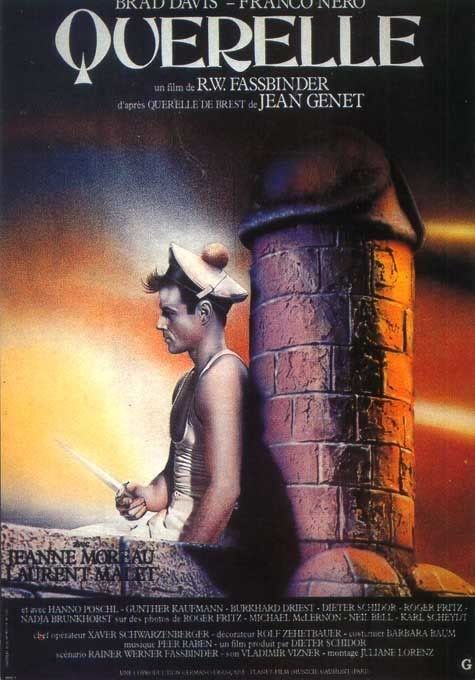
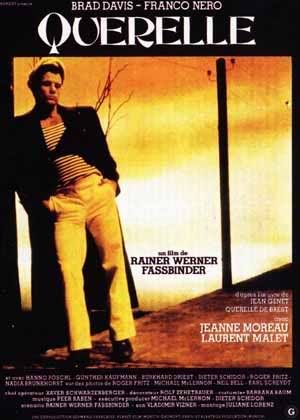
5 Stinky Thoughts on Querelle (1982) - The Queer Film Blogathon

StinkyLulu offers the following "5 Stinky Thoughts" as my contribution to the Queer Movie Blogathon instigated by Queering The Apparatus:

click image to be routed to video

Thought #1: Each...
...and every film that StinkyLulu contemplated in preparation for this event illuminated one aspect of what StinkyLulu so treasures about queer film: Female Trouble's garish, gaudy sloppiness; Poison's giddy genre games; Parting Glances's smart, sexy subterfuge; Shortbus's explicit, passionate, acrobatic and memorably musical perversions; Bell Book & Candle's oblique curves; Law of Desire's puddling heat; The Queen (1968)'s heart-stopping theatricality; Watermelon Woman's meta-cinematic marvels; The Times of Harvey Milk's lost moment in time; Cruising's buttfuck homo panic; Myra Breckenridge's buttfuck gender panic...it's a dizzying merry-go-round of faggots and trannies and queers --- OH MY!!! Yet, even as each of these titles gives its own distinctively heady whiff of the pungent power of queer cinema, only one film -- in StinkyLulu's experience -- delivers the full wallop of the complete bouquet: Rainer Werner Fassbinder's queerest conundrum, Querelle (1982).

Thought #2: Man...
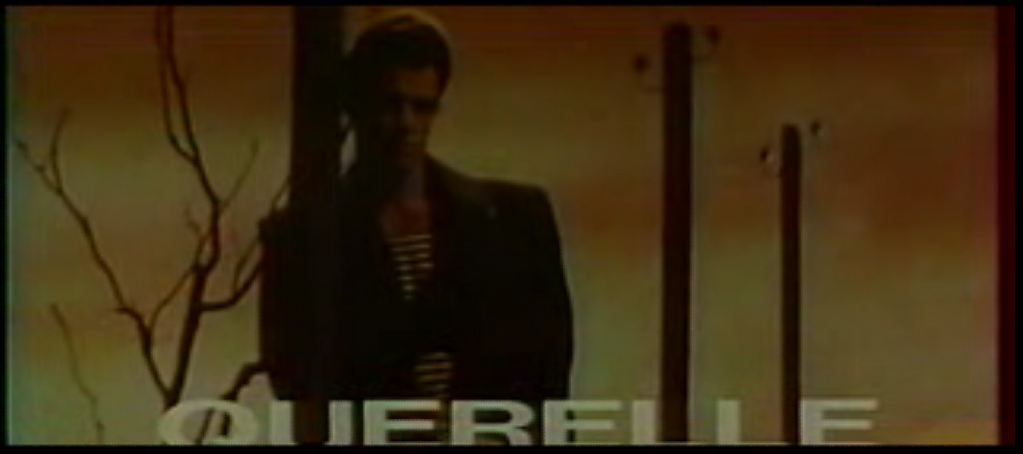
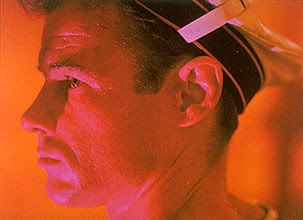
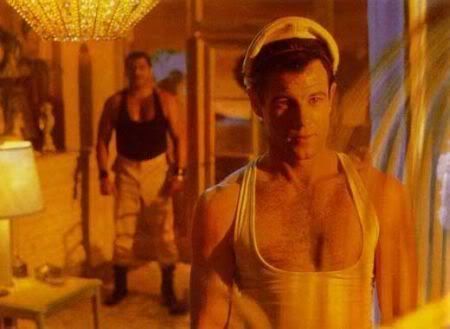
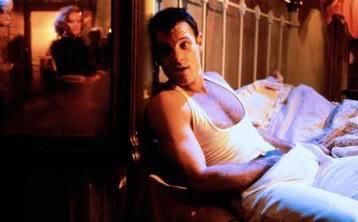
...whatta a man, whatta a mighty -- Fassbinder's Querelle (like the Genet novel from which it riffs promiscuously) presents a sweaty meditation on a diverse range of eroticized masculinities, arranged in constellation as a testosterone-soaked backdrop for the narrative's shooting star: the sailor/cipher Querelle (a breathtakingly beautiful Brad Davis). Fassbinder populates his film's landscape with tawdry two-bit Tom of Finland knockoffs to underscore that Querelle exists as an active object of/for penetration, which -- in the film's brilliant distillation -- operates as a synedochic gesture of masculine abjection, objectification and transcendence (video). Everyone wants to fuck Querelle. Or kill him. Or both. The journey of the film follows Querelle as he intuitively reconfigures himself to perform himself within the roles constructed by the film's various, salacious gazes. As Querelle, Brad Davis -- in a performance that's equal parts dim-witted pout, adolescent arrogance, and penitent surrender -- offers an astonishing portrait of a man "becoming" more than "coming" out into a different, and differently dangerous, self...

Thought #3: Kills...

...me that the film is so easily mistaken for a "kill the faggot" movie (example 1, 2). Yes, there's a lot of death and violence there, and the film does end with a hopelessness that's chilling, but Fassbinder does something with this narrative that's resoundingly profound: at its core, Fassbinder's Querelle reminds us that queerness itself is a matter of life and death. The "choice" to express one's queerness is mortally dangerous, the choice not to -- perhaps more so. For me, Querelle is Fassbinder's homage to his queer forefathers (Genet of the novel, Wilde of the "each man kills" epigram), an acknowledgment of the deadly stakes of queer erotic -- and queer aesthetic -- self expression. This homage is perhaps the part of the film that's most elusive to contemporary audiences, the overlay of homo=death being a bit too much to bear. Indeed, Fassbinder's Querelle arrived in the early 1980s -- right as Vito Russo's influential Celluloid Closet thesis (film wants gays and lesbians dead) started to take hold and just as the apocalyptic onslaught of the early AIDS era began to be felt and at the same time of the filmmaker's now mysterious death and not long before Brad Davis's own HIV-related passing. A mournful caul yet surrounds Querelle, somehow obscuring Fassbinder's shocking lucidity about the queer condition: that the costs of living queerly might be high, but the costs of not doing so are equally grim. It's this stark poignancy that I admire so about Querelle, this vivid, life-&-death portrait of the queer conundrum...

Thought #4: The Thing...

...that gets me every time, though -- even as I'm wrestling in the pit of Querelle's queer conundrum -- is just how darkly humorous Fassbinder made this film to be. It's basically a comedy. See, every time it gets all superhorny or superprofound, Fassbinder ruins the moment with a brilliantly sloppy joke. The film's intense imagery is so conspicuous that it's easy to get all hopped up about -- oh -- Brad Davis getting plowed, or to get all grim about the violence, the misogyny, the racism. But, truth be told, every seam of the film is sutured with brutal irony, simply riven with courageous camp. From the genius goof of the voiceover, to the phallic scenography, to the silly fight choreography, to the fact of Jeanne Moreau's cabaret act. The whole film is a deep dark camp joke, albeit layered with porno-spiritual overtones, and laden with life-&-death consequences. BUT just such a mix is -- to me -- the absolute essence of queer film.

Thought #5: He Loves.

Indeed, that StinkyLulu - he does love this film. Fassbinder's Querelle is hard work, to be sure, but there's a generous, tender, truthfulness amidst the shocking camp, hypertheatricality, lurid violence, terrorizing sexuality, and roiling despair -- something worth hacking through your own fears and judgments to get to, I promise. Of course, StinkyLulu's a bit biased: Querelle happens also to be the first film to truly shake StinkyLu's proto-cinephiliac foundations. When I saw it for the first time, in a college class twenty years ago, Fassbinder's Querelle was "the" film to fundamentally inspire me to think deep and hard. I had been watching movies carefully, thoughtfully, adventurously for ten years already, but Querelle was the first film to truly demand that I start engaging film as I had previously only engaged literature and theatre: as a mode of creative, aesthetic, intellectual, spiritual self-inquiry. So, Fassbinder's Querelle -- in a very specific way -- "took" my cinematic innocence (which was hardly naive at the time), insisting that I begin to understand that movies would no longer just be diverting commodities but essential waystations on my path to myself

So, lovely reader, do you have any thoughts on the queerness of Querelle?
Do tell... And be sure to check out the sweaty queer cinematic action
over at the
Queer Movie Blogathon HUB @ Queering The Apparatus

10.17.2007

5 Stinky Thoughts on Montgomery Clift - The Montgomery Clift Blogathon

I offer this post, somewhat anxiously, in the spirit of homage and tribute, to The Montgomery Clift Blogathon instigated by Nathaniel over at The Film Experience. Be sure to click through all the amazing posts accumulated there for much fascinating (and less ambiguous) appreciations of Montgomery Clift.

Thought #1: Monty Scares Me...
At the risk of being indelicate, I've got a confession to make. I've always been more than a little unnerved by Montgomery Clift. I've never crushed, never admired. To be entirely frank, I've spent most of my Clift career trying to not look away, trying not to get completely freaked out by him. Of course, this may simply because I've gotten to know Clift backwards -- beginning toward the end of his filmography (with The Misfits at the Brown Film Society during Freshman Orientation) and never quite making it all the way to the beginning. And, truth be told, I think I've seen only five -- maybe six -- Clift flicks from front to back. Mostly because I avoid him. I find his presence so palpably haunting that it's hard for me to focus on the film when he's in it. (I mean, anyone who can upstage La Judy in the damage department has got something going on...) I keep waiting for Supporting Actress Sundays to drag me toward the earlier films. Perhaps he's less terrifyingly damaged there? But all the excerpts, all the clip shows, everything I've seen leads me to suspect that, through the lens of his life's later disasters, the sweet vulnerability of his earlier work carries a differently frightful depth of melancholy. But, yeah, Montgomery Clift sorta totally skeers me.

Thought #2: Monty Makes the Ladies Crazy

The only Montgomery Clift film I've been known to get totally caught up in is the 1959 guignol delight, Suddenly Last Summer. There's just something delicious about the metatextual pleasures of this one: a brain damaged Clift threatening to lobotomize Elizabeth Taylor? Of course that's a movie I can watch again and again. I'm perhaps most captivated by Clift's inadvertent impact throughout the film. His arrival makes Hepburn's Mrs. Venable pre-menopausal again. His vaguely fixated gaze awakens a catatonic Liz. His mere presence in their midst makes a whole gaggle of Snake Pit-ettes go completely bonkers (and, in a loony bin, that's quite the accomplishment). Indeed, in this most hysterical film, Clift functions as catnip for crazyladys... and it's just wild to watch. (Notably, he does perform pretty much the same way in 1958's Lonelyhearts.)

Thought #3: Monty's Real Parents?
Ever since reading Sam Abel's essay in Passing Performances ("Staging Heterosexuality: Alfred Lunt and Lynn Fontanne's Design for Living"), my whole concept of Montgomery Clift has been overdetermined by the notion that he was the kind of person that people "adopted" emotionally. According to Patricia Bosworth's biography, the acting team of Alfred Lunt and Lynn Fontanne gave Monty a signed a picture of themselves: "From your real mother and father." Abel suggests that Lunt-Fontanne "took an interest in Clift specifically because of his homosexuality, trying to protect him from a hostile public" (Abel, 190). Even more perversely, this legend holds that Clift imitated Lunt's manner/affect as an unconscious gesture of homage. This notion -- that Clift would shapeshift in performative gratitude -- both frightens and saddens me.

Thought #4: Monty the lolly?
Looping back to Thought #1, I sometimes wonder if the reason Monty scares me so is that he's one of the few Old Hollywood lollipop heads who seems to never hide the hugeness of his head. I get all anxious that his big noggin's agonna keep getting bigger until it snaps his little neck, or floats him away, or something else all freaky. (Toldja Monty Clift scared me.)

Thought #5: Monty, oh Monty.
Looping again to Thought #1, it seems only appropriate that I conclude with another confession: as much as Monty freaks me out, saddens me, and haunts me in ways I don't understand and cause me to avoid his movies -- somehow, honestly, I sorta totally like the guy. No reason, no rationale, just do. So, dear Monty -- many across the blogosphere adore and admire you, but you've made a specially freaky place for yourself in StinkyLulu's strange little heart. Blessings.

4.16.2007

5 Stinky thoughts on Grindhouse

With MrStinky out of town this weekend and with mounting threats to cleave its epicness into bits, 'tseemed necessary to prioritize a theatrical screening of Grindhouse. And, lo, was StinkyLulu glad to have done it. As an experience, 'twas both exhausting and exhilarating. (StinkyLulu arrived home & was wired for hours -- that like to never happens these days.) So, if you can, lovely reader, do rush out and catch the rollercoaster ride for yourself. 'Tis a four hour experience, so you may need to take the day off, but 'tis truly worth it. Can't really think of a film that's as much about the movie-going experience -- good and bad -- as this one. It's not necessarily a great movie, but it is an enthralling event with at least a little something for every movie freak... StinkyLulu, then, offers the following 5 Stinky Thoughts (which are, to the best of my limited ability, spoiler free) as both reward and incentive...

Thought #1: Oh, that Robert Rodriguez.
With Planet Terror, StinkyLulu enters the ranks of Robert Rodriguez's most weary fans. The man's clearly a brilliant and charismatic organizer. He can marshal more effects, actors and character schticks than anyone. Perhaps ever. And he's a brilliant scenarist -- creating the most enthralling and clever scenarios for cool characters to maneuver. But, criminy, RR just seems unable to tell a story in a way that sustains our emotional investment in all those totally cool things happening on screen.

Thought #2: The Sign in the Box Office Window
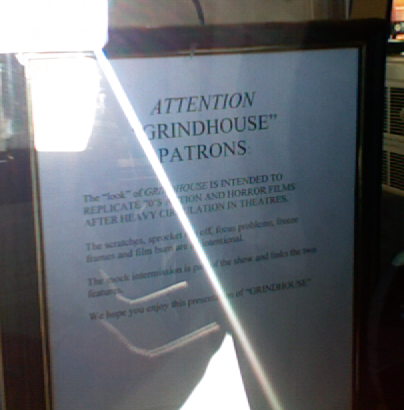
Last week, Stale Popcorn marveled at the American movie-going public's palate. And when StinkyLulu arrived the to the googaplex and noted the "warning" sign in the box office window...basically warning that the film was supposed to look like that...well, StinkyLulu just had to wonder. Golly. How dumb are U.S. movie-goers? To be sure, Stella Liebeck (the McDonald's coffee lady) was from ABQ so it may be that we are especially dumb in the Land of Enchantment. Then again, maybe it's not a question of smarts. Perhaps it's more that contemporary filmgoers are profoundly uncurious/uninterested in matters of cinematic style? (PapaStinky once tried convince StinkyLulu that a dvd-playing in "letterbox" mode was due to a manufacturer's defect.) Whatever the explanation, signs like the one in the box-office do not bode well for even mildly adventurous commercial filmmaking.

Thought #3: Can the interstitials get their own sequel?
Oh my jeepers. Those previews? Those "this film is restricted" cartoons? That psychedelic swirl between segments? Such filmgoing flashbacks. Lurv it. StinkyLulu could just watch that shit for hours. Literally. Hours. Honestly. Those interstitials are what elevate Grindhouse into the realm of the sublime.

Thought #4: OK. Is Eli Roth a...well, you know?
Just askin'...

Every time StinkyLulu sees/hears the man speak, that special "spidey" sense starts tingling. And a certain "ooh-wa" sound starts on loop. Maybe it's just the way he touched that other horndog's arm at the bar...with that curiously prolonged fingerpoint? I dunno... Like I said. Not sayin' -- just askin'...


Thought #5: Death Proof is pure genius.

And it's all about the structure. QT very subtly organizes Death Proof into three acts, using little bits of Grindhouse schtick as bridges between. Thus organized, QT uses the first two sections of Death Proof to immerse, inoculate and initiate the 2007 audience to his chosen genre and its two main pleasures: tawdry tedium and gruesome sadism. Then, in the third section, QT deploys a set of genuinely charismatic char/actors to subvert the genre and its gender politics in startling and gratifying ways. TO EXPLAIN: Death Proof's first section (Jungle Julia) is all about the insipid voyeurism and languid, pointless titillation of schlock pics. The characters are barely distinguishable -- same bimbo, different flavors -- and are generally uninteresting (to the point of annoying). Plus, the basic scenario gets way too complicated, with so many flailing threads that it's easier to stop caring. The main point of this section, though, is to introduce Butterfly (the gorgeously retro Vanessa Ferlito, on whom StinkyLulu now has a total girlcrush), tracking her uneasiness and slow seduction by Stuntman Mike. And just as there promises to be a horndoggish payoff for all this tawdry tedium, QT interrupts the proceedings with a simple bit of fabricated "Grindhouse" schtick. (At the sparsely populated screening I attended, the offending intertitle elicited audible groans of frustration. Cinematicoitus interruptus, if you will.) Then, with an abrupt cut, QT zooms Death Proof into the film's second and briefest section -- that I'll just call "Left Turn" -- which gives full ride to the lurid sadism of the genre and which has women taking all the hits. Hard. That's followed by a denouement-like bridge to what looks to be a lamely appended but generically-appropriate "explanatory" epilogue (featuring, in a nice twist, a few intertextual treats in the shape of characters from Planet Terror popping up). Then, all of a sudden, QT yanks us into section three -- with Death Proof's only continuing character now clearly up to the usual tricks. But the film's feel has changed. Everything's a teensy bit clearer, brighter, more contemporary in feel and sound than anything up to this point in the film. Even more, the characters are interesting, as are the performances of most of the actors (especially Rosario Dawson and Zoë Bell). There's an ominous weight in the air, to be sure, but the patter of the four women keeps things amazingly light. (That round-the-table work in the diner? Evokes the contrived whimsy of Sex & The City even as it ratchets up the terror; imagine if Carrie and the gals had a really scary stalker... That scene's one of the best things Tarantino's ever done. Right along with the incredible, extended stunt set-piece that follows. Not to mention that crazy fist fight at the end. Wow.) With Death Proof, Tarantino's genre obsession finally marries with his storytelling ability and genuine interest in performances by powerful women. It's easily his most mature and successful work. And, quite frankly, it might be the first film in which Tarantino finds a way for the audience to ride shotgun on his filmmaking joyride.

So, lovely reader, do you have any thoughts on the wonders of Grindhouse? Do tell...

4.07.2007

5 Stinky Thoughts on Cruising

StinkyLulu offers the following "5 Stinky Thoughts on..." as my contribution to the Trashy Movie Celebration Blog-a-thon instigated by The Bleeding Tree:

click image to be routed to video

Thought #1: Bad Cruising, bad!
Cruising (1980) still seems to hold the power to hurt people's feelings. The film, which -- arguably -- doomed William Friedkin's career is mostly acknowledged today as the really bad movie around which a then little-known underground film critic named Vito Russo organized a set of protests (forerunner to the Basic Instinct protests of the early 90s) that instigated a generation's interest in queer cinematic representation. Indeed, along with CBS's 1967 "documentary" The Homosexuals and BI, Cruising's nearly the ür-text of modern queer media activism. Nevertheless, Cruising's got a veritable smorgasboard of queer delights: a deliriously confused "whodunnit" narrative; Pacino in all his 70s studness; gay predator/s feasting on gay victim/s; a psychoanalytic explanation of the killer's motives that's the stuff of ex-gay therapeutic fantasy; howler dialogue ("Hips or lips?"); lurid, forbidding, hypersexualized homo imagery; a great period soundtrack; even a minor-celebrity-cameo fisting scene. All told, the movie's just a big hot gay mess of macho homo panic. And, golly, if StinkyLulu doesn't just lurv it... Every filthy bit of it.

Thought #2: Passing As Gay
Cruising's narrative depends upon a simple fact of gay ghetto subculture: not so much that gay is good, but more that -- at least here -- gay is the norm. Further, gay macho imagery runs as electric current throughout Cruising, upending conventional banalities about gay effeminacy every stomp of the way. This makes for a still enthralling scenario at the center of the film's narrative conceit: in order for Pacino's character to "pass" as gay, he must not only become a closeted heterosexual but he must also amplify his performance of his own masculinity. Pacino's Burns -- the tough guy straight cop in real life -- often fails in his attempts to pass as macho, as tough, as manly enough to be believably gay. In a particularly evocative scene, almost precious in its simplicity, Pacino's Detective Burns is refused entry to a club on "precinct" night because he doesn't look enough like a cop. And then there's the sequence when Pacino's Burns worries he's not attractive enough...

Thought #3: Feelin' The Disco Freedom
With little doubt, StinkyLulu's most very favorite scene in Cruising is at a key beat in Pacino's characterization of Steve Burns. Pacino's Burns hasn't been able to find his gay groove, which is getting in the way of his truly going undercover. His attempts to flirt are dumb and clumsy. He peeves one guy as he's ignored by another. He slowly begins to realize he's being outmanned by these homos. They're taller. They're more muscular. They're hotter. They're not all that into little Pacino/Steve. Then one guy asks Pacino's Burns to dance, and Pacino allows himself to be led to the dance floor. And then it's a lyric from a Sandra Bernhard monologue: "Then the guy pulls out a little bottle and shoves it underneath your nose. They're poppers - you've never smelled them before and you're starting to get kind of nervous and dizzy and sexy and hot and sweaty and into the rhythm and you walk out to the dance floor but inside your head it keeps echoing "But I'm straight! I'm straight, man! I'm straight!"" And with a straight/white guy arm jagging set of moves, Pacino/Steve Burns all-of-a-sudden finds his gay groove while feelin' the disco freedom and he joins the tribe cruising the gay ghetto. It's an almost radical depiction of the fluidity of sexual identity. Plus it's just a hoot.

Thought #4: The Men of Cruising
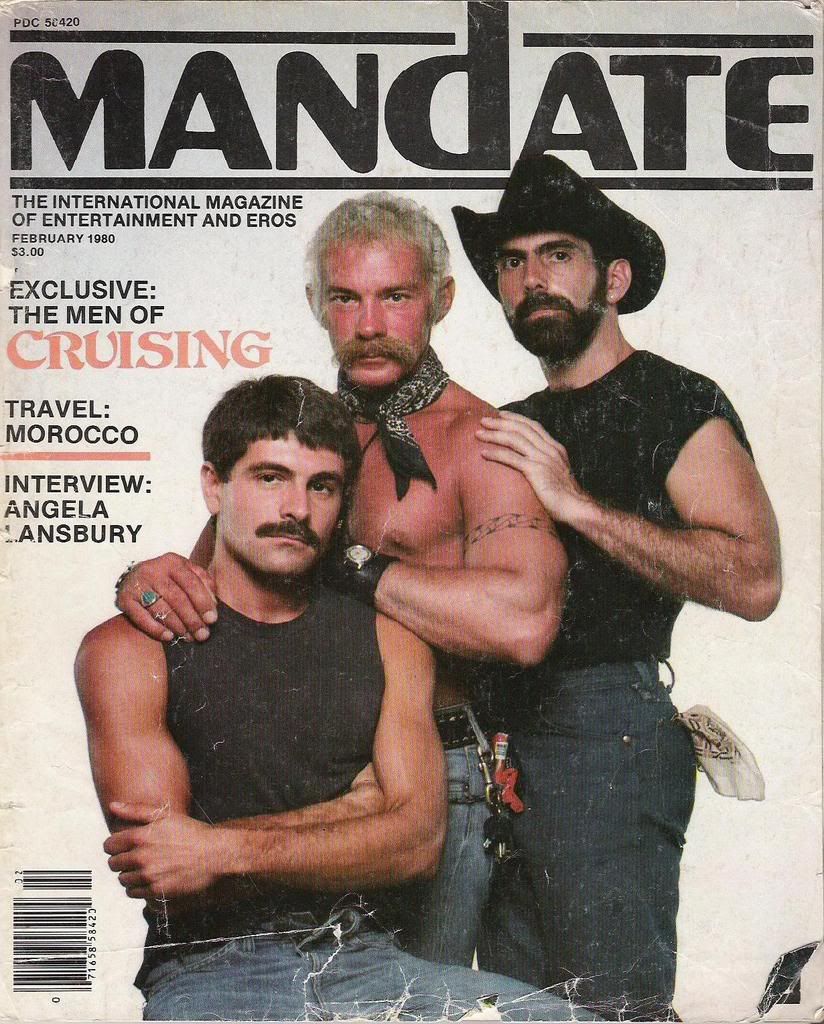
As many things as Cruising gets wrong (those tranny prostitutes are just beyond even genderf*ck plausibility), the flick's got some footage in it that's almost an ethnographic portrait of urban gay sex in the 70s, more frank than anything this side of a Joe Gage or Christopher Rage film. Friedkin's team used real leather bars/clubs as locations, paying selected clientele to hang out and be extras. The extra gig rated $50 a day ($125 in 2007 dollars) -- more if they appeared nude, semi-nude or while "simulating" sexual acts -- plus free poppers and (if the rumors were/are to be believed) a free flow of drugs and booze. Indeed, being cast as one of the "Men of Cruising" became a choice day job for those living in the gay sexual underground. And for others, like those interviewed in an extraordinary article in the February 1980 issue of Mandate, appearing as extras in Cruising represented an opportunity to be out, proud and sexually free -- "to represent" their "lifestyle" to a mainstream audience. The crowd scenes in Cruising are a thrilling, tawdry and vivid portrait of a sexual subculture at a particularly sophisticated yet innocent historical moment, now long gone...

Thought #5: A Brilliant Homo-Panic Passion Play.
At its most basic, Cruising's not so much a murder-mystery as it is a brilliant homo-panic passion play. Here's a careerist macho cop who, slugging for a promotion, agrees to an assignment that requires him to take a huge swan dive into the gay leather scene. And the question of whether or not Al Pacino's character becomes "tainted" by his full-body immersion into gayness emerges as a bigger deal than "who's the killer?" By most reports, the orignal screenplay scripted a sexual identity crisis for Steve Burns, a character arc that Pacino sought to deemphasize. The final screenplay obscures this through sheer incoherence. But, in the film's final resolution, Friedkin reintroduces the idea that Pacino's Burns might just have "gone native" in a particularly appalling way when Steve's fiancée unearths some leather accessories from his closet just as Friedkin cuts to a gruesome crime scene, wherein Steve's only gay friend is found brutally murdered. In this moment, the film opens a question: did Steve go over to the "other" side? Did he become gay? Did he become the killer? This notion of the "taint of gayness" -- that a mere brush with male homosexual behavior threatens to "turn" male heterosexuals gay OR instigates an instinctual panic justifying murder of the tainting homo -- evokes the most vicious, essentialist, homophobic rantings and ravings. This entrenched American sensibility operates as the heterosexist corollary to the racist "one drop" rule, and Cruising's spectacular cinematic incoherence stands as perhaps its most effective portrait...

So, lovely reader, do you have any Cruising thoughts? Do tell...
And be sure to check out the action at the Trashy Movie Celebration!

3.15.2007

5 Stinky Thoughts on Inland Empire


Thought #1:
I hate David Lynch. & then I love David Lynch. But then I...

It's been 20 years since my first experience of the deep palpable physical misery of a 1st screening of a David Lynch film. A Lynch film is the cinematic definition of "discomfit." Then, of course, the obsession kicks in & I only want to watch it all over again. Somehow believing I might be able to unpuzzle it with a second look. Ha. Got me again... The f*cker.

Thought #2:
Actor's faces.

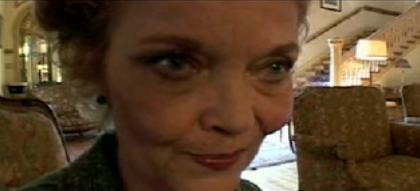
Few contemporary American directors love filming actors more than Lynch. You can see it in the way he frames their faces. It's a worshipful cruelty. And it captures the shocking and surprising contours of an actor's performance in ways almost unique to Lynch. Think of that big sidewalk scene and how Lynch's fascination with each actor's face amplifies gory absurdity into something startling...poetry. The f*cker.

Thought #3:
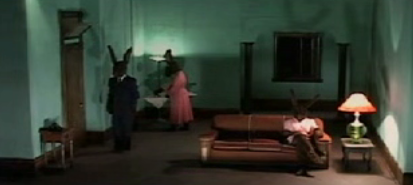
What was with the big bunnies?

Perhaps the most elliptical visual Lu's seen in a good while. For Lulu, the big bunnies were the source of some of the greatest tension in the film. At first I got to thinkin' the big bunny scenes cued some big concept about life & voyeurism & theatricality & rodents...but then I got confused. And toward the end I was just dying -- actually bouncing up and down in my seat -- in anticipation of Laura Dern crashing through that stage right door and then wandering among those big bunny people. (Gawd wouldn't that have been kewl?!?) Not that it would have said anything in particular about what was going on with those f'n bunnies. (What was going on with those bunnies?) And not that it actually happend. Lynch. The f*cker.

Thought #4:
The genius is in the casting.

Lynch casts smarter than almost anyone. Tosses seasoned pros in with novices. And he then adds non-actors for spice/spite. And, here, he gets all international on the cast too. And then he puts big stars in voiceover or in background during the marvelous closing credits. (Behind, of all things, a rollicking lipsych number performed by -- truly, if I read the credits correctly -- students from The Debbie Allen Dance Academy.) Who else would do this? The f*cker.

Thought #5:
Why doesn't Laura Dern work more?

No. Really. Why?