
 Yesterday was the deadline for Academy Award voters to submit their nomination ballots and, perhaps because of that fact, I find myself thinking out loud in a guest post over at The Film Experience about what appears to be the single remaining mystery about this year's contest for Best Supporting Actress: who will be the category's "fifth" nominee? Could be a "coaster"? Like Sigourney Weaver in Avatar?
Ponders the myriad pathologies of pop culture.
Obsesses about actressing at the edges.
Loves grilled cheese.
ARCHIVE OF SUPPORTING ACTRESS SUNDAYS & THE SMACKDOWN
Showing posts with label coaster. Show all posts
Showing posts with label coaster. Show all posts
1.24.2010
The Question of "The Coaster": Sigourney Weaver in AVATAR (2009)
Yesterday was the deadline for Academy Award voters to submit their nomination ballots and, perhaps because of that fact, I find myself thinking out loud in a guest post over at The Film Experience about what appears to be the single remaining mystery about this year's contest for Best Supporting Actress: who will be the category's "fifth" nominee? Could be a "coaster"? Like Sigourney Weaver in Avatar?


10.05.2008
Beatrice Straight in Network (1976) - Supporting Actress Sundays
 He's baaaaaack. This week's Supporting Actress Sunday profile marks a few noteworthy milestones. First, I'm back on track with Supporting Actress Sundays through the end of the calendar year, following a brief interrupt. Second, I think my Vivien Merchant profile might have been the 150th "official" Supporting Actress Sunday profile, so we're edging ever closer to that elusive halfway mark. Third, this week brings our attention to one of the most referenced Supporting Actress winners in the history of the category. Not because Oscar-philes think she's all that but because her performance is largely considered to be the briefest among the 71 trophy-snagging Supporting Actresses. Of course, I'm talking about...

...Beatrice Straight in Network (1976)
approximately 5 minutes and 13 seconds
3 scenes
roughly 4% of film's total running time
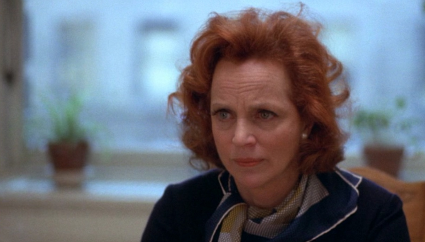 (A SIDE NOTE: Oscar geeks who track such things might notice that my time count for Straight's performance is slightly lower than standard estimates which range between 5:40 or so and right at or above 6 minutes. It's worth remembering, then, that my criteria for clocking supporting actress time does not measure the entire scene but only those moments in which the actress is visible, audible or otherwise "present" in the framing of the sequence. For me, then, Bill Holden's whole speech about Diana Christensen's "scripts" for their relationship, in which Straight is neither seen, heard nor inhabiting the camera's point of view -- that whole speech doesn't count toward Straight's screentime, even though she's still ostensibly "in" the scene.)
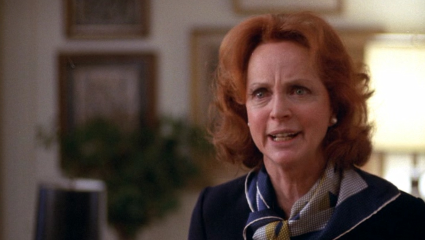 Beatrice Straight's performance as Louise is widely remembered as a single scene bravura turn, in which in the space of a mere handful of minutes Straight's Louise journeys through all (or nearly all) the stages of grief. Such an appreciation of Straight's work is not in and of itself incorrect, but I find that I really like the fact that we get to know Straight's Louise just briefly in an early morning scene. In this brief early sequence, Louise awakens to discover that her husband's friend and colleague Howard Beale (the deservedly legendary Peter Finch) has gone missing.
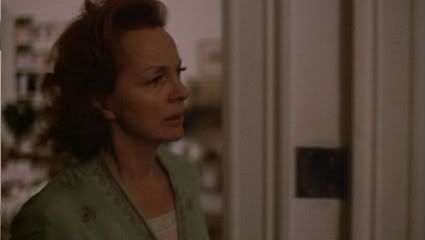 In this easily overlooked set of moments, Straight lays a savvy foundation for all that is to come later, establishing Louise as an elegant, smart and empathetic woman, possessed of a wry sense of humor, a woman who knows her husband very very well.
 This foundation serves Straight well in the main confrontation scene, in which she first absorbs the information of her husband's sustained infidelity before launching into a brilliantly articulate tirade about his actions and their consequences.
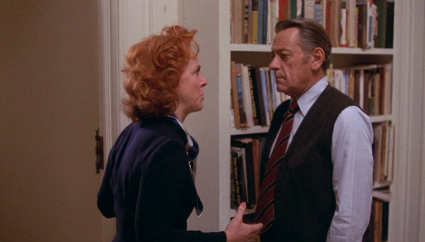 Straight's Louise then begins to dissolve a little, her resolute anger crumbling in an onslaught of genuine pain and sadness.
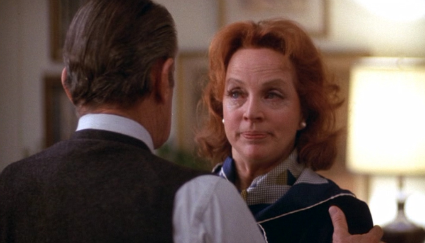 What's great in this moment, in both how it's scripted and how it's performed, is that Louise's abiding love and affection for her husband includes concern for him even as he's making a choice that devastates her. In this moment, when Louise asks if her rival loves her husband, Straight assures us that Louise is no patsy, no doormat, but a smart, worldly woman who understands that her husband's happiness (or lack of it) will continue to inform her own.
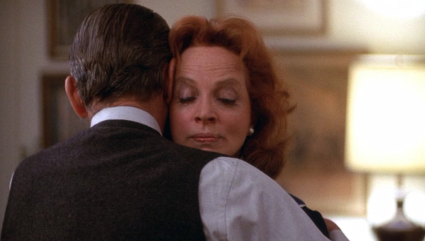 I especially admire Straight's clarity throughout this scene. Her Louise is a fully crafted characterization, clearly possessed of a rich history and complicated inner life, separate from the spare scenes in which we get to see her. This depth of characterization not only amplifies the vast array of emotions on display in the concentrated jolt of her single main scene but also establishes Straight's Louise as an example of what emotional integrity actually looks like.
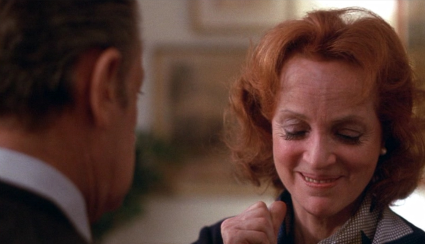 Yet what remains most impressive to me is how vividly Straight animates this portrait of a dissolving marriage, even as she's got a wooden post (oops, I mean, William Holden) for a scene partner.
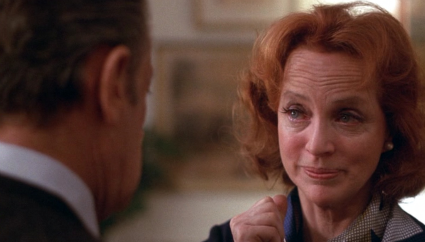 Beatrice Straight's work in the role of Louise Schumacher is deft, intelligent and humane, a blast of emotional clarity within a narrative mostly characterized by manipulation, hype and deception. I suspect Straight's win, and even possibly her nomination, marks hers as one of the most noteworthy "coasters" in the category's history. ("Coaster," attentive readers will recall, is my term for a not unworthy supporting actress performance that nonetheless "coasts" onto the Awards roster largely because of the general surge of nominations for the picture of which it's a component part.)
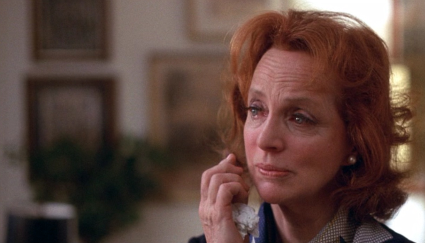 Straight's work is solid, demonstrating genuine empathy, clarity and dexterity, and it will be interesting to see, as this month of Supporting Actress Sundays unfolds, whether Oscar's briefest awarded performance turns out to be among the year's worthiest.
Subscribe to:
Posts (Atom)